Posted in Current Events

Safety First, or, As American as Violence

Today I discovered that the FBI released a public service announcement and website on how to attempt to survive a mass shooting. The FBI. The biggest law enforcement agency this country. It’s not even new; it was released three years ago, and just happened to hit my feed today.

Run. Fight. Hide.

If this messaging sounds familiar, there’s a reason for it. 

American politics and policies have long put the onus on the victim to protect and defend themselves. It didn’t start with active shooter drills in elementary schools. Gay folks in the armed forces were taught that they could avoid sexuality-based violence if they kept their mouth shut. Women have been taught for decades how to avoid getting sexually assaulted. Black families have taught their children how to interact with cops so they don’t end up jailed or killed. 

Systemic issues should not place the burden of safety on the individual. And yet, here we are. 

This country was built on the blood and bodies of innocents. The colonizers didn’t see indigenous people as people. Still don’t. 

This country was built on the backs and by the hands of people stolen from their homes and enslaved across oceans. The slavetraders didn’t see black people as people. Still don’t.

This country was built on the unseen labor of women and fertile wombs. The patriarchs didn’t see women as people. Still don’t. 

This country was birthed from violence, and begets, and begets, and begets. 

“It could never happen here.” It could. It has. It does. It will.

Four years ago, I was in the minority (along with my public health friends) who were aware that this country was not prepared for a pandemic. You can’t shoot a virus, so I guess there wasn’t much funding. 

Twenty years ago, I didn’t live with the weight that any day, in any public or semi-public place, I could be a victim of a mass shooting. Columbine was supposed to be a once-in-a-generation tragedy. So was the Oklahoma City Bombing. So was 9/11. 

It has been going on so long I don’t even want to say that it isn’t normal. Because now, it is. 

In my line of work, we like to use simple visual tools to convey big ideas (stay with me here). The one that comes to mind is from OSHA, the organization responsible for ensuring occupational safety. Here it the hierarchy of controls, courtesy of Wikipedia: 

Can you see where we are on the chart? Where marginalized folks have been for generations? 

We are at the personal protective equipment level. 

The hazard has not been removed. It will not be. 

The hazard has not been replaced. It will not be. 

People have not been isolated from the hazard. They won’t be. 

The way people operate their day-to-day lives has changed, it can be argued; but not for safety, not on a societal scale. 

We are at the point of the triangle, where the individual must accept that no one in power is going to do fuck-all for them, and it is their own responsibility to survive the violent actions of other individuals. 

I’m not saying it’s not an important video and message to get out; I’m not saying it won’t save lives. It will. My point is, even though it shouldn’t have to, there are not enough people with enough money and enough power who can eke out a single fuck to give.

I don’t have a solution. Well, I have some ideas, but they keep getting squashed in the hallowed halls of the government. Call this a rant, call this screaming into the void. The video tonight just made it crystal clear that, for some time now, I’ve understood that on any day, it could happen here. And you know what bothers me about that, is how matter-of-fucking-fact it was. Just like, oh, might rain on Thursday. Might cause traffic problems. Might get shot while doing the grocery shopping this week. 

And it’s coming out like this, rage pouring through my fingers, as I sit here knowing my daughter is sleeping soundly having no goddamn idea about this yet in the next room. It breaks my heart and strengthens my resolve that I know all too soon, she, too, will learn that she might be next. 

Check out the video if you have the bandwidth. My daughter will learn how to stop the bleed. How to run, hide, and fight. 

May that she, and you, only ever know the fear of it happening and not the reality. 

Posted in Memoir and Memory

Irrational, Inescapable Fears

Anxiety is a siren. She beckons, her voice sliding in to wind around my mind. I don’t want to hear it; I don’t want my thoughts to follow her sly whispers, but they are drawn along against my will. She does not sing of that which I most desire, but rather, she has charmed my fear into giving her my secrets. She sings of the death of my loves while I stand helpless, of my own violent end as if I am already half-ghost. 

It was stormy last night; no lashing rain or blanketing snow, but fierce winds that whipped through tight screens and rattled loose shutters, and the temperature plummeted to -10 Fahrenheit. The hundred-year old house groaned and snapped, the heat clattering in pipes that sound off in the walls. The poor dog, anxious during any storm, was practically climbing the walls. She’s mostly deaf at this point, so whatever sense she has of storms must also be confusing when she can’t hear what we can. Still, she seems more comfortable outside than she does in during a storm. She stands facing the wind, her scraggly hair blown back as if she stands on the prow of a ship. She looks fierce in her Thundershirt and her long eyebrows swept back, and has to sniff every individual leaf that has entered the yard since the last time she was out. Then she comes in, shivering, looking pitiful, and only wants to be wrapped up in blankets.

The lights flickered as I made dinner, and I swore I could hear Hawthorne’s urgent voice. “Get the candles in one place. Fill the tub so we can flush the toilet, only pee in the downstairs one! Where are the beans? WHERE ARE THE BEANS? Oh, okay. What pot can we use on the stove? I’m going to make cowboy coffee! Maybe. Where’s the Mokapot? Better grind some coffee while we still have power, I’ll get the hammer to smash more just in case.” I think they were just waiting for their once-in-a-lifetime storm, the kind they heard about from their dad, who snowshoed to his parents’ home in the blizzard of ’77. They had already been through Buffalo’s October storm of 2006, but they wanted their legacy blizzard in Vermont.

It was comforting to think of them as I ran through my mental checklist. I knew where the candles and lighters were; the external battery for the phone was charged. We had plenty of pantry items, and we were not in a situation where we would be stuck without power or heat and with no way out. The extent of my storm prep was to text my cousins and ensure they knew that they were the backup plan if we lost power. It was too cold to mess around with that, and without another heat source.

We kept power; it didn’t even flicker hard enough to disrupt the evening run of PJ Masks. It was Friday night, so the TV stayed on a little later than usual, and we read a couple of extra books. By 8:45, I was ready for Lucy to go to bed, although she wasn’t quite convinced. As she climbed in, however, the siren’s song slipped past my defenses.

I was afraid that she would freeze to death in the night, and I wouldn’t be able to save her.

I stood, watching as she bounced around her toddler bed, avoiding laying down, and I tried to tell myself that was a silly thing to worry about. Her room was warm, the heat was on; I’d wake if the power went out and various things beeped a last complaint, and I would be awake at least twice during the night to let the old lady dog out. She was in no danger.

Do you want to take that risk? Are you willing to gamble on losing again?

I gave in.

It wasn’t hard to convince her to come to my bed. By 9PM, I had the fleece blanket I’d made Hawthorne on the bed, so Ella would have a soft, warm place for her belly, and Lucy tucked up on the inside of my bed, already hogging my pillow. I brushed my teeth and laid down, mentally checking off where my sweatpants and socks were, my robe and extra blanket for letting Ella out. It took Lucy a long time to settle down – relatively, I mean, for a three year old. Within fifteen minutes, my hand was rising and falling with her steady breathing as it lay on her chest. 

At this point, I truly do not know if I could survive losing her. And so the siren sang me to sleep.

I’ve had all the standard advice about anxiety, from deep breathing exercises to medication to “just don’t think about it.” Those things can usually keep the irresistible song to a dull roar, and I can function. 

Last night was just one of those times where it reached out and wrapped around my mind, pulling me against my own volition. I didn’t even try to fight it, not more than the most cursory effort, anyway. It had been a long and difficult week for my anxiety, and I simply did not have the effort, or the fucks, to give. Twenty-four hours later, I have no judgment and no regret. It was a simple fix; she climbs into my bed most nights anyway, jolting me awake in between puppy bathroom breaks. We all slept well and warm in the refuge of my bed.

One day, giving in to the siren may be my downfall, though it’s hard to think of how. Maybe it’ll keep me from taking a trip; maybe it will tell me to not allow Lucy to go off to college alone. I’m not really worried about that.

What I am worried about is that one day, the siren will speak truth, and I won’t hear it until it’s too late. Until I am too late.

So I listen; and some nights, when the wind whips and the temperatures dive deep, I follow her song and aim willingly for the rocks, and I take no chances.

Posted in Beliefs and Practices

Dia de los Angelitos

We kept the celebration small this year. The kitchen table was pulled out, the basket of condiments banished to the pantry for tonight. There were 6 place settings crowded around the square table. I pulled the three chairs I owned in around in and added the stepstool; the kiddo would get a kick out of that. Lucy had her high chair, and I was happy to stand. Truth be told I was too excited to sit. 

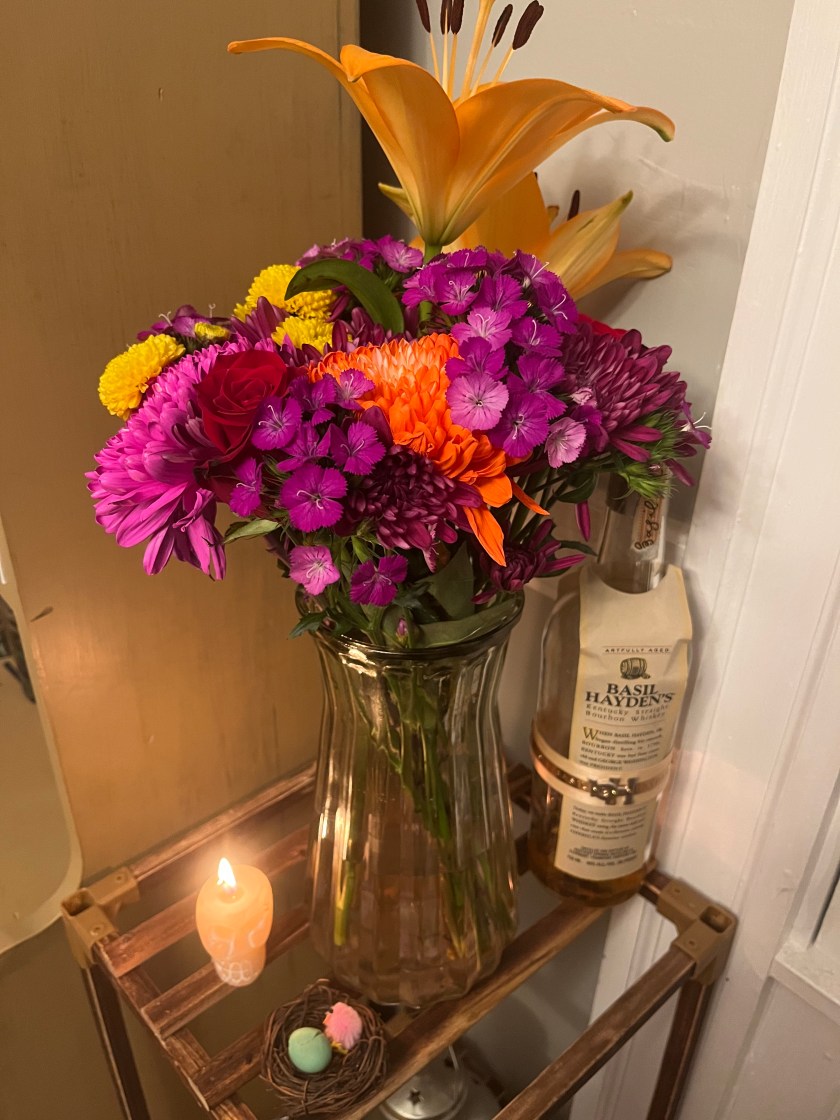
We set the table together, with silverware clattering on plates, as “Lucy Danger” and “gentle” don’t always go together. The sun had set already, and the sky was vaguely purple with the cloud cover and light pollution from the city refracted inside it. I fiddled with the vases of bright orange carnations, and bit my lip as I worried that they were not marigolds.

Suddenly, there was a rush of warmth and the voices of our beloved guests poured into the room. Lucy was startled and ran to grab my leg a moment, but found herself swept up in hugs.

Oh, but they looked wonderful. They’d all dressed up for the occasion. Stan, in his suit from the church picture that his wife had taken, shit, must be ten years ago now; Clark, a fresh flannel button down and pressed slacks, with his hat and walking stick and sunglasses. Hawthorne, dapper as could be in a lavender button down, jeans, vest, bow tie, and pocket chain. And Oscar, my sweet boy, in a checkered Oxford shirt and suspenders on his jeans.

He’s gotten so tall, a full head taller than his sister, who was looking at him with wide eyes from her perch up on Clark’s shoulders. He’d be four now; he sure seemed like it. Lucy kicked her legs and demanded “down, down please!” Clark lifted her off his shoulders and put her down, and I watched my children, my babies, run into the other room to play. Their grandfather went with them, a smile on his face that I could tell reached his eyes, even with the sunglasses.

I turned from hugging Stan, who followed in to watch his grandkids play, and found myself back in my spot, head under Hawthorne’s chin, their arms wrapped right around me. We fit perfectly together there, and always had. I breathed them in; sandalwood and calendula, and the smell of their skin that I remembered so well. I wanted to pause time, to feel those arms hold me like no one else could, to lay my head on their chest where it fit so naturally. The bossa nova station I had playing on my computer slid toward something slower, wrapping around us as if we needed help holding on to each other. We swayed in place a moment, then Hawthorne tugged my hand. I spun away and back in, laughing into their eyes. We danced in the kitchen like we had so many times before. 

The kids ran in, demanding food, followed by the men. Hawthorne gave me a last squeeze and let go, reaching to pick up Lucy as I turned to the stove. 

“Hey, baby. Remember me?” 

Lucy  nodded. “You Papa,” she said, pointing. My eyes stung, and I closed them against the wave of emotion. She was always to ask to look at pictures, and didn’t always recognize Hawthorne. “That my Mama,” she continued, the same way she told her friends at school every time I came to pick her up. “Who that?” 

“That’s your brother Oscar,” Hawthorne told her. 

She gasped. “My picture!” She strained to get away, and since neither of us knew what she was talking about, they set her down. She ran into her room. “Mama, my picture!”

We all followed her in, Oscar pushing through legs to get to the front to see. Hawthorne gripped my shoulder and tears filled my eyes.

She was pointing to a painting given to us by our beautiful and talented friends when we had been pregnant with Lucy. A branch of a birch tree against a truly Oscar blue sky – she had color matched it to pictures we posted of our Oscar sky. On the branch was a birds nest made of twigs. Inside the nest was a gold crown, and half of a perfect egg. Well, when it had been given to us, it was the shell of the egg, glued on like the twigs and the crown; the shell had been broken during the move. Lucy asked about it often, asked why it was broken. I always told her it was because she had hatched, and the crown was for her brother Oscar. He left it here when he went to the stars, I would tell her. 

Lucy climbed up on her bed, turned and gestured to Oscar. “C’mere,” she told him. “My picture. My egg broken, I hatch. You has a crown! My picture!”

Stan clapped his hand on my other shoulder. “Ya done good, kid,” he said as he turned and walked out. He wasn’t much one for displays of emotion, his own or that of others’. Clark echoed the sentiment and action. “Well done,” he nodded, before stepping out. The kids began chattering about the books on Lucy’s shelf, and we watched our babies play. 

The timer beeped, and I ran back to the kitchen. It wasn’t a traditional dinner in any sense of the word. We had chicken nachos with Chiavetta’s, shepherd’s pie, shrimp cocktail, cereal with milk, and ice cream. We sat and ate the smorgasbord happily, passing things around the packed little table, then one of the grandfathers would turn easily in their chair to place the dish on the counter. Oscar got a kick out of sitting on the top of the backwards stepstool. Wine flowed and beer foamed, raised in toast, and enjoyed without any negative anticipation. All were well here. 

After dinner was finished, I pulled out a cake I had hidden in my bedroom, away from little fingers, frosted with bright orange flowers. I lit the candle and brought it out carefully. Hawthorne, Clark, and Stan joined in singing Happy Birthday to Lucy, and she clapped along in her Papa’s lap. Between us all, we managed to eat half the cake, and polish off a tub of ice cream with it.

Despite the sugar rush, Lucy and Oscar were both beginning to droop after the meal. We moved to the living room, where there was just enough space to have Stan and Clark each take a comfy seat in a high-backed chair known for cradling its occupants. Hawthorne and I snuggled up on the couch with the kids. I took our son into my lap, and Hawthorne held our daughter. We sat and talked, sharing family stories we never had a chance to, as well as old favorites. I caught them up on the highlights of the year. They had felt some disturbance through the veil, more of the unpleasant things that I tried to lighten in the retelling. I didn’t want to dwell on the hardships and illnesses, the tears and sleepless nights. I wanted this bright, golden memory. 

We continued to talk as the candles burned low, and the grandfathers each drifted off to sleep. I held Hawthorne’s hand over the back of the couch, surrounding our sleeping babies. I was having trouble keeping my eyes open any longer, but I didn’t want to let go. Hawthorne laughed and my head came up; I’d fallen asleep and kept talking, nonsensical ramblings. I shrugged and smiled. It’s not like it was the first time that had happened. I laid my head in their hand as they murmured to me, all the little things we used to say in bed together, before they rolled over and I’d curl around them to finally fall asleep. A tear slipped from my eye – I knew they would be gone when I awoke, my lap back to being space for only Lucy, my couch and house otherwise empty. The dog would wander around, confused as to where her family went. I didn’t know how Lucy would respond. Another tear fell, and Hawthorne wiped it away with their thumb. 

The last thing I heard was them telling me they loved me, with the weight of Oscar back in my arms, before the candles faded out and I drifted off to sleep.

I hadn’t needed the marigolds after all.

Posted in Uncategorized

My Apologies to Anne Shirley Cuthbert

October is unpacking her bags, filling up the dark corners of my mind. She is wily; she smiles with knowing eyes and bared teeth, as she knows she is right on time. She makes herself at home, walking over victories and bright memories and turning them to dust beneath her feet. She tucks sharp, intrusive thoughts into hidden nooks and settles words that bite like vicious rats into their daytime cages. She crowds the space with self-doubt and unhappy history until there is no room left for the light to wind through. Seratonin maintains its feeble protest at the edges, still present because it has no choice, but rightfully intimidated. 

I hate October.

I used to think it was because it marked the death of my father, now sixteen years gone. It bleeds into winter, and the death anniversaries of my grandmother and my great-uncle. Our family is small, and the loss of those 3 people in a two-year span felt like a cleaver. We didn’t do holidays together anymore. My mother held hard feelings about the other family members around her perception of how much they cared; she was wrong, but the bridges had already burnt. I maintained contact with everyone; certainly no one had asked or intended, but I felt the pressure as the only thing keeping our family together at all. Now, I am keenly aware of that feeling in its new form after the losses of my father-in-law, my son, and my wife. I have almost no contact with my in-laws, and none of the wherewithal to try to span that chasm. 

I remember being afraid last year of what the dark winter would bring. I had been diagnosed with seasonal affective disorder at some point, but I’m not sure I recognized it as such until last year. I would tremble on the way home and cry in the driveway, the baby sleeping in the back, at the thought of facing another night. It was less that it was another night alone, and more the unrelenting darkness. 

The first winter after Hawthorne had been so full of things to do – pack, move, find an apartment and a job, transition our whole lives to a new chapter. Seasonal symptoms were masked or obliterated by raw grief. I didn’t have the time, mental space, or energy to even think about anything else. I was still in therapy, and trying to find a therapist in my new state to move to. I had no local friends yet, and the first Covid vaccines had just been released for those at the highest risk, so most of my family was still hibernating. October’s manifestation had been silenced that year. 

I was anticipating it to be rough last year; bad, but not as bad as it was. I functioned; I took care of Lucy, I went to work. I made plans with people, had standing dates for dinner, and tried. The exhaustion felt different; it felt false and unearned. I felt robotic, and after I had gotten Lucy to sleep, could feel myself power down. I would put the TV on and tell myself I was invested in the show, pull the blanket up to my chin, and sleep. Most nights I wanted to stay there, not having the energy to get myself to bed, but the fear of withdrawal from not taking my antidepressants eventually pushed me to my room. 

One night in February, I called a help line. I wasn’t thinking of hurting myself; I already hurt enough. I did not want to kill myself, but the intrusive thoughts of simply not wanting to be alive anymore terrified me. It wasn’t the first time I’d felt this way; the last time I had, I’d gone to a peer mental health respite house. So that’s who I called. 

Just that connection, to a landline phone hundreds of miles away, tethered me back. Two things had just happened: I had called out for help in my weakest moment, and the call had been answered with love and compassion. At 11 PM on a February night, the first flicker of dawn shone gray through the deep and the dark. 

For the holiday season, I had gifted myself a solo writing retreat in a cabin in New Hampshire. That trip came less than two weeks after that phone call, and those two actions are definitely in the top 5 best things I have ever done for myself. That was when the light began to come back. The skies didn’t fully clear for another month, but hope began to grow in the frost-hard ground. 

This past week was a harsh reminder of last winter. I’d had flickers of worry over the spring and summer that this was going to be bad again, but I felt bolstered by the work I had done. I had spent five months waitlisted and am now working with a therapist who is incredibly well-suited for my needs. I have a network of friends and family, local and not-so-local. I have lists upon lists – self-care ideas, people to call, things I’m looking forward to. I’m making a tangible toolbox with these handwritten lists, colorful stones, pretty happy stickers, and my action plan, updated and yes, colorful. 

I have the tools, the supports, the plans to get through this upcoming winter as healthy as possible. I know who I can call when I’m sad, when I’m scared. I will be OK; it’s just that getting there is going to suuuuuuuck.

I don’t want to hate October. I’m not generally a pumpkin spice latte fanatic, but if not for the darkness, I’m much more L.M. Montgomery – I’m so glad to live in a world where there are Octobers. I like football, and apple picking, and fall fests and leaf peeping and all the beautiful benefits of living in New England in autumn. I try to fill my days with them, soaking as much sun in as I can before the light changes to gold, before the evening arrives earlier and earlier. 

The clocks will change soon. I’ll reset the three in the kitchen, the last I have that don’t update themselves. I’ll change the batteries in the closet lights so I can see my clothes without waking the little one who occasionally stumbles in for 2 AM snuggles. I’ll turn the heat on, weed the garden one last time for winter, and trim back the branches that have started to block the way to the trash bins. I’ll get Lucy a new heavy coat and new boots, and pack up my sundresses. Garland of leaves will be hung, costumes finished, birthday plans made. I will stand outside and stretch my arms out and lift my face to the thinning light, trying to warm myself like the cormorants on the rocks.

Spring will come, with its tulips and its birdsong. October will last exactly thirty-one days, and the following months at their prescribed intervals. Even in winter, the sun rises. 

I would have made a terrible Alaskan. 

Posted in Uncategorized

Reluctant Time Travel

I’m back.

Back where I don’t want to belong, or at least, I don’t want to belong. Yet I find myself here, again and again. 

Back in that cool fall room, the morning mist still rising from the recently shaded lawn. Even as the leaves fell, the shadows deepened, and the buzz of insects was slower to chorus. 

Not from exertion, but from having it stolen, I stand out of breath at the doorway. My wife lays in bed, not noticing my approach. The scene glitches, and then they lay on the floor, pale and cool, wearing only red plaid boxers and top surgery scars. We had joked so often about the near-translucent whiteness of their pale skin; now it was the brightest color in the room. 

I don’t want to belong here. I don’t want to be here. 

I don’t want to find myself here, over and over, when I am running down the sidewalk, waking up from a dream, startled by an unexpected hand on my shoulder; this is where I wake. Thanks, I hate it. 

I hate that the vision I have of the love of my life is, most often, their death.

Sometimes, the doorway is as far as I get. I stand there, frozen in time, staring, unable to move.

Sometimes I feel the bones in their chest break under my hands. 

Sometimes I am pacing in another room, begging for someone to come while the first responders push breath and electricity into someone who doesn’t need those things anymore.

Sometimes I walk out the front door, dazed, and see the volunteer firefighters in a social distance half-circle around Lucy in her stroller, too small to be strapped in that way. 

I have never been in time. 

I have never had a do-over; never got there early enough, never yelled loudly enough for them to hear, never threatened – then followed through – on calling 911 if they didn’t answer. 

They never answered. 

Sometimes, in the bright sunrises over the duplex homes on our street, I’ll remember the last time I saw them alive. The soft moments just after dawn when I had tucked them in after a bath when they’d been unable to sleep, nuzzled the recently buzzed baby duck hair, and told them I loved them. Get some good sleepies, I said, and slipped out the door while they were still asleep.

What if I hadn’t? What if I had stayed while they’d slept?

For years, I have prized my early-rising morning time. My body has never liked sleeping in. And now, that morning especially, I wanted to write. I had just started really writing again – just the week before, I had posted for public accountability that this blog would be updated every two weeks. I figured the off-weekends would be the best time for actually writing, so I was at my desk with full-octane coffee. I was no longer pumping breastmilk for the baby, so when she woke up, I’d changed and fed her, and settled in her swing next to my desk for her first morning nap. I was tapping away at the keyboard – like mice tap-dancing, according to Hawthorne – when the sound of their snoring coming through the floorboards changed. I listened, and didn’t like how long it took the next one to sound out. 

Sometimes I go back to walking up the steps, and think I remember thinking about getting the phone, unlocking the door. But I didn’t then, and like I said, I haven’t had any do-overs. 

I remember the turn of the stairs, my thick socks cushioning my steps down the hall. I couldn’t hear the creak of the swing or the tinkly music, but knew I’d hear Lucy if she cried. Then I’m back at the doorway. 

I don’t know if it was grief or parenting that made me realize what a bullshit construct time really is. The two have been intertwined for me since July 19, 2018. Some days, I look at their picture and wonder where they’ve disappeared to, since the house isn’t that big. Some days their life seems like it was too long ago to count in anything but eons. 

It’s been two years since I first walked into our bedroom and found my wife, too pale and still for this world. It’s been nearly that long since I physically stood in that bedroom. It’s been about three hours since I was last there. 

This is not what I thought time travel would be like. I mean I suppose I should have expected some pain, what with the rearranging of atoms across the time-space continuum, but this keen slicing of paper-thin sheets of my heart is a little much. The wail of grief is well imprisoned, an iron mask that no one really wants to acknowledge; if they did, they’d have to face their own certain mortality, and so many people just aren’t ready to think about that. Who is? Only those who have been given no choice, their brush with it close enough to feel her breath. 

Have you felt it? 

I live with that breath inside me, entwined in me. It has the most intimate knowledge of my lungs, my arteries and veins. I have carried life in my womb, and in my arms. I have carried death in both as well. Sometimes I feel she walks alongside me, and the touch of her hand to my shoulder is the trigger that sends me back across time and land to arrive, again, at the open bedroom doorway. I am the time traveler, but it is at her whim. 

I want to belong at home, here at my desk, tap-tap-tapping on the keyboard like mice in the walls. I want to belong with the scent of farmer’s bouquets, pungent and spicy as the world turns toward autumn. I want to belong where the laughter of my daughter is, and her increasingly clear speech.

But I don’t; at least, not only there. 

Time passes when I’m in the bedroom doorway. It starts out bright, the early morning September sun streaming through the bathroom windows and onto the floor just where I stand. It moves; the beams of light grow shorter as the sun rises higher, changing the angles. I stand, staring, as the world continues to turn around me. I don’t want to belong here. 

But I do; at least it’s not only there. 

Grief is a trickster, for all her sad smiles and damp eyes. She’ll fool you without mercy. Death is the one who makes things happen, who pushes the buttons and programs the machine. Time is a construct, a scarecrow, a nonsense creation that falls apart and gets stuck back together at odd angles. These three sisters, hair falling down in mobius curls; they are muse and master. There is no one that they have not touched, not rock nor tree nor person, let alone a displaced people. We are at their mercy, of which they have none. Always a step ahead, up around a quiet corner, waiting; waiting until you are right where they want you. 

And what do we do? We fight back, because that’s what we’ve been told. On the ambulance, we raced to the scene, sirens screaming down side streets at all hours of the night, letting everyone in earshot know that we were the front line against death. We buy cards with platitudes, console people with thoughts of being in a better place and sanitized images of angels. We buy cream after lotion after facelift in order to turn back the clock. 

For all of that, though – the bravado, the Hallmark and Oil of Olay profits – we fight back with hope, and continued solidarity, intrinsic to our corporeal bodies. We rise, and breathe in, then out. Over and over and over again. 

Time passes, smoothly or in fits and starts. Grief waxes and wanes. Death eventually takes our breath for her own.

I am standing in the bedroom door, watching the chest of my wife fail to rise and fall. I breathe in, then out, over and over as I stand, immobilized, wishing for this not to be true. Eventually I awake, and I am back. I breathe in, then out. And I rise for another day.

Posted in Uncategorized

Take A Walk With Me

I am falling asleep at my computer; the record validation I am working on is going smoothly enough, it’s just tedious and I’m tired. Lucy’s schedule does not change for September, yet I feel like she’s already trying to stretch both ends of the day in the anticipation of returning to school.

So, with no meetings on the calendar, I take myself for a walk and head across the street to the little beach. I step deliberately on the bright shards of glass, grinding them further into the rocks and sand under my thick-soled boots. The glass here is not a gift from the sea, but the recent litter of people, so I like to play a small part in smoothing their edges.

About ten feet out in still-shallow water is a worryingly large splash, with no bird near enough to associate it with. This cove is rather industrial, and my imagination runs wild with visions of mutated sea creatures that feed on the pollution, pulling down the occasional gull from the surface.

A white band circles the water’s edge, marking an earlier tide. The pale skin of dried seaweed chokes out the grasses in a narrow strip. I use this as my guide; above the line is dryer, the stones and shells paler, while below the line everything is covered with a thin veneer of still-wet sediment. 

When I walk the beach, I find no bones. Those are gifted to me, at odd moments and at odd places, and never where I think I will find them. Instead I find crab and clamshells, and rocks broken under human intervention. So many of the stones you expect to find at the beach – rounded corners, soft edges that lay smooth in your fingers – have been abruptly interrupted. Maybe they fell to just the right pressure in just the right spot as they were buffeted by construction to sheer off into a flat surface, or thrown against a sharp boulder to crack them open and reveal the darker true color of the sun-washed stone. I take my phone out and make a note: stone-crossed lovers searching for the other half to the one they hold, meeting on the beach and discovering each other. Yeah, I can work with that. 

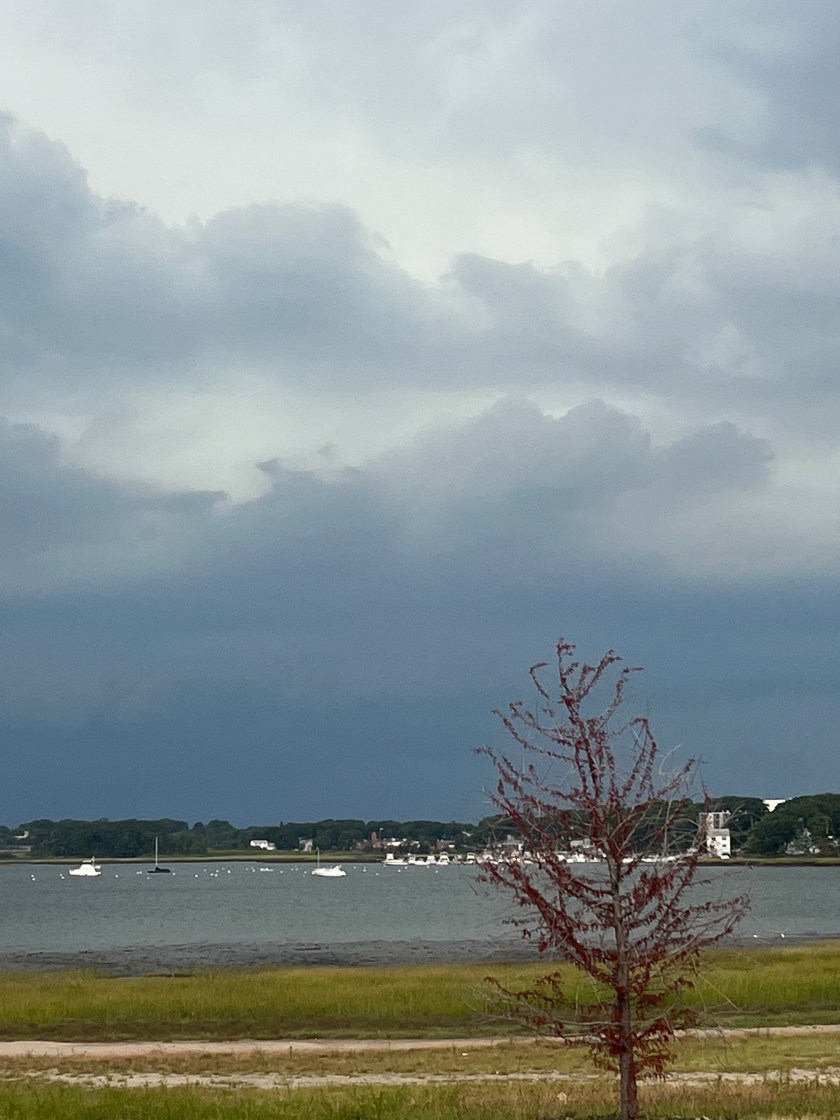
Thunder echoes in from the direction of the wind, and I look up to thick gray clouds. There’s no rain yet, just the tease of it on the humid air. The cove is sheltered, so there really aren’t any waves to join the strengthening wind.

I approach a tide pool in direct defiance of the thunder as the gulls begin to sound their alarm. There’s no life in the pool that isn’t already strewn along the rocks; periwinkles and limpets that cling to broken shells, turning what was once the home of a single mollusk to a crowded apartment building. 

As I begin to walk back up to higher ground, I think of the starfish story, and remember Hawthorne throwing back shell after shell stacked with new inhabitants. There is nothing here that I throw back, nothing I need to save; even as I’m thinking this, a clam spits out a warning from beneath the surface. The stream just misses the toe of my boot, and I laugh. They have their own defenses that don’t include a flight from my hands. Sure, they are more likely to be caught and eaten out here on the drying shore, but they’ll survive the cyclical rise and fall of the sea. Any who do become stranded will be quickly dispatched by the gulls. Such is the natural cycle of life on the beach.

I stoop and pick up a stone; quartz, it is jagged and pocked. I am always on the lookout for hag and wishing stones. This is neither, but it is oddly warm when I pick it up – I don’t need to scan the beach to know it is empty of people, even as it teems with life below me. The skin prickles on the back of my neck, and the cracking sound in the roll of thunder demands my return to the damp cool of my basement office.

This isn’t the first time this has happened. Sometimes I will pick up a stone in the forest, or a shell on the beach, and find it feeling like it has already been held, warmed by hand other than my own. I wonder who it is. I wonder who walks with me; I wonder if they bend more easily than I do, or if pain still resides in their spirit, the very atoms scarred. If so, what scars are we made of, what marks do we carry as we are conceived and borne and grow? What pock marks and holes and missing pieces are we made of? Which star bled for each of us? How can we continue to consume and consume from our world and not give back, when will the universe demand it’s due? The number of people who die in a day are replaced within minutes. What is that if not the road to catastrophe?

The first fat drops of rain hit my back at nearly a 45-degree angle. Already the rain is coming in, driving itself sideways, hurrying those like me who’ve tarried too long, breathing in the energy of the coming storm. I wonder how Lucy’s day is going; if she’s feeling it, and being a little shit. My poor dog, I’m sure, is huddling behind the front door, her recent safe spot. I wasn’t expecting a storm and neglected to put on her Thundershirt. I’ll come home to a puddle inside the house, away from all the windows, my poor old lady. She’ll get some extra cuddles tonight, which will be easy since she’ll become my shadow the moment we get home.

I don’t have pockets in this dress, so I carry the stone with me and put in on my desk. It joins a couple pieces of glass, my wind-up toys, and a curved piece of broken shell that spoke to me on the very same beach when I was first transferred to this office. It might stay right there, just north of my keyboard; or it might join the plants in the window, enjoying the turns of shade and sun. I wonder if it will be warm when I pick it up, and who will hold it in the meantime.

Posted in Uncategorized

The Least Competitive Person in the Room

There is nothing in the world quite like dirt therapy, I thought as I knelt, shifting every few minutes to ease the sting of grit on my knees. The drought-dry dirt lacks the soft landing of planting season, or even harvest. Shallow roots come up easily; even the tough knobby joints of the wild violets give up their stronghold, and dandelions dangle their long tubers from my grip. Still, it only take a couple breaths until my exhale is a contented sigh. Even when it’s 82 degrees at 7 am, I find refuge in the garden.

Ella wandered around the yard, sticking her nose in every nook and cranny she hadn’t seen in a while. When it’s just the two of us, I can let her wander in the quiet dawn, though it takes some coaxing to get her out of the house without it now. As I pull the invited plants from the garden, I watch her explore the spaces she cannot usually reach: the far corners of the yard where the mismatched fencing meets, the rotting wooden posts behind the tiger lilies, the dried stalks at a permanent-until-pulled lean. I worry a moment she’ll get her head stuck where the two fence slats are missing, but like her human sister, she figures it out without my assistance. 

This was reentry week. I have been out of work since the beginning of June, as I played gracious hostess to a lovely intestinal parasite that moved in and wreaked havoc on my body. I was supposed to go back to work on Monday, only somewhat eased in by a 4 day workweek. I felt ready as I could be; the only part I was dreading was opening my email. The rest, I felt normally nervous about. Figuring on that anxiety to only grow exponentially until Monday morning, I tucked these quiet moments in envelopes in my mind, labeled by light and scent, to pull out when I needed. 

About an hour later, not liking the cough Lucy had woken up with, I wrapped her in a thin blanket to  keep her some semblance of still and stuck a Q-tip up her nose. Covid positive. Well, shit.

On the first day Lucy was pretty much fine. She was vaccinated, and acting pretty normally; there was no need for immediate concern. At first I was, selfishly, more upset about the timing. My friends had been planning on coming in for months; I was all set to head up to Vermont, a place I will always consider home, and take the next step in my dream. I had a writers conference to attend, and an appointment to pitch to an agent who might be interested in my book. I was feeling ready to go back to work, hopeful, armed with my updated notebook and shiny new mindset.  But I shrugged, said c’est la fucking vie, and prepared to hunker down in quarantine with the kiddo. 

Within a day, my symptoms were starting. The sore throat came first, sharp and uncomfortable; less than twelve hours later, on my way to get tested myself, I felt my bones catch fire and my whole body begin to weep. I almost turned around to go home and curl into a ball. By day three, I had the cough and logged less than 600 steps. We were a sorry pair, for sure; we spent the weekdays in our pajamas til nine, the TV on almost constantly, and doing our best imitations of potatoes. I kept up on Lucy’s over-the-counter medication regimen better than mine, and she repaid me by spending the majority of the hottest days sprawled in my lap. The threatening storms had Ella practically attached to me as well, none of which helped the fever that pushed against the Tylenol. Lucy still seemed mostly herself, just subdued. She continued her moratorium on taking naps at home, even as I struggled to simultaneously rest and stay awake with her. 

My anxious and fevered brain began to ramp up when my eyes closed. I remembered being in the PICU last year, with RSV and pneumonia, looking at the uneven tiling in the bathroom by the locked doors. I remembered the 24 days she spent in the NICU before she could come home, this tiny human that didn’t even break 5 lbs until three days before she left. I remembered getting the steroid doses into my body with minutes to spare, to help fortify her underdeveloped lungs were born via emergent C-section at exactly 34 weeks. 

I dreamed of Oscar, gone before he could take an earthside breath. I wept for Hawthorne, who had lived their last months in fear of this new respiratory virus they were convinced would be their death. 

That’s when the guilt hit, taking full advantage of my weakened defenses. 

I hadn’t protected Lucy. I hadn’t stopped her from getting Covid. I had let this plague get to my preemie daughter – because no matter how old she gets, I’ll never fully get past those first 24 days.

But, I reminded myself, had protected her. She was vaccinated, as soon as she was eligible. I took her to one of the first available clinics for her age group, and she’d had the second dose not quite two weeks before. I had done everything I could, for the 870 days since the pandemic was announced as a public health emergency. She is one of the youngest kids I know of to be vaccinated. I don’t need the headlines to tell me that the uptake by toddler parents is frighteningly low; I can see it by our clinics. 

We are coming out of it now, definitely on the upswing. I’m still exhausted, but other than that one day, we’ve gotten outside to at least get some fresh air, and usually a walk around the block. The sunshine, as well as the rain that finally broke the heat, felt so good. I am so glad and grateful that we were vaccinated. I’m completely certain that without it, we both would have been much sicker. Even as it was, it’s nothing I’d want anyone else to get, so we stayed away from people all week, and practiced wearing a mask, too.

I go back to work next week, providing my testing is clear. I’m a tad anxious, which feels about right. I don’t want to think of this as the summer of sickness. I want to think of this as the summer I learned, the hard way maybe, that I need to take better care of myself (and sooner); I’ve got someone watching every move I make. And I’m done feeling guilty; I can acknowledge that I did, and be proud of reminding myself that I have no reason to. And if Hawthorne were to somehow take it up with me from beyond the grave, I’d bank on their competitive streak, and point out that in the grand scheme of the three of us, I went the longest without getting it – that is to say, (morbidly, I know), I win. 

Posted in Uncategorized

Sway Like No One is Watching

It’s been over a year since I have experienced music live, more than three since I had a ticket to a performance in another city. I thought I knew how much I missed it; I thought I knew how much I associated live music with love. 

This week, a good friend took me to see one of her favorite musicians, Takenobu. They were playing at a club I had sworn I’d been to before, but after going, I don’t think I had. People were respectful of the masking rule, free masks were available at the door, and everyone had to show proof of vaccination. I felt comfortable in the space, as small as it was; we made quick friends with the woman on my right, a recent college graduate and new resident of the city. When the unassuming couple took the two steps up to the stage, silence swept the underground room. 

I had never heard of the musicians, at least, not knowingly. I didn’t know anything about them other than my friend was super excited to see them. I just missed the experience. 

It only took the first song to have me hooked. We were maybe ten feet away from the musicians, just the 3rd table from the tiny stage. Their movements flowed like water, bows sliding over cello and violin strings. It was beautiful, and appeared effortless. The music simply lifted from the fingers that played it. This was not music you listened to; this was music you breathed. I felt it with every inhalation, as I filled my lungs with the sound and let it go, let it surround me. The voices that rose were the perfect complement to the classic instruments. 

By the third song, I was actively swaying in my seat. I noted that my friend was as well; everyone else in my line of sight sat statue-still. I didn’t understand that, never had. Could they not feel it? Feel the way the music moved around them, electrifying the cells in their bodies, coaxing the movement from their limbs? I had an image of a ballet performance in my head, the dancers reaching forward as if their fingers were desperate to feel the music run through them, even as they were pulled backward by some other invisible force. I wished it was an open floor plan; I wished for the confidence and the grace to be able to get up and dance the way the music was insisting. I wished I’d worn a long skirt that would continue to flow with the movements of my hips after they changed direction. 

I absently noted the passage of time only because the clock was in my direct site. The brass hands made their slow sweep over black as the view out of the high windows went bright as the streetlights came on. The violin and cello continued to make their easy transitions, moving from smooth notes drawn out with the bow, to playful with quick plucks of the strings. I noticed a familiar hand pattern; yes, the cellist was finger picking the cello. I felt the excitement bloom in my chest and turned my head to tell Hawthorne. Oh, right.

As happens when I get really into something, I had lost track of where and when I was, swept away in the music. That surrender is how I had danced for our entire wedding with my shoes on the whole time; it was what made road trips fly by as fast as the highway outside. It had been a long time since I felt it. It was what happened when music and joy and love and wonder converged. 

The music swelled with meaning, not just from Takenobu. Bright memories of both my first and last loves washed over me in time-hazed pastels. Half-running from the train to get to the little club where we had ten-dollar tickets to see someone we had barely heard of, waiting to snuggle up and sway together in the sweaty crowd. Having a mountain of a man put me and my skinny boyfriend in front of him, protected from the pit forming behind us. Hawthorne dragging me closer to the stage so they could watch the hands of the musicians. Sitting on the grass and watching their eyes sparkle in the dusk. 

I pressed a fist to my heart to hold it, that joy, that sweet ache of beautiful memory. This is what live music is about, I thought. This has been missing from my world. 

The last time I’d heard it was at the jam at the Wild Fern where we had gathered to celebrate Hawthorne’s life, just over a year ago. I felt that sweet ache falter towards something more painful; applause rose around me and brought me back to the moment. 

We drank our craft beers and savored the rich mouthfuls of tres leches cake we split. I watched the young person in the corner write page after page in the notebook balanced on their knee, occasionally reference a book with a pink cover and long title that I couldn’t make out. I remember those days, where any moment I sat was a moment to study. I made notes on my phone, regretting the absence of my own notebook. I didn’t want to be rude, but I knew I needed the words that moved through me to be captured and not carried away on the music. 

Suddenly I heard bars I’d recognize anywhere rise to dance on the air. The instruments were different, but suddenly I was on a mountaintop in Vermont in midsummer, bonfire lit, chairs pulled up to the light, Hawthorne and friends picking up the key and melody. The melancholy rendition of Shady Grove transported me so that the woodsmoke obscured the young student, the café tables and fake candles. I could see the faces of friends, of my love, as if they were there to reach out and touch them. My heart squeezed. I pulled up a favorite picture of Hawthorne on my phone and set it on the table; for a moment, just for a beat, they were with me at the show. 

Takenobu finished their main set, then told the story of why they don’t actually leave the stage at Club Passim, and then immediately began their encore. We paid the bills that were handed out, heads bent toward bright phones and paid by QR code. I thought of when my first boyfriend and I went, the black X’s on our hands and cash carefully folded into his pocket. I looked around at our masked companions, and hoped he was still going to shows. 

The show ended at what, at thirty-six, was the perfectly reasonable time. Twenty years ago, my boyfriend and I would be wondering if another act was coming on. Instead, my friend and I joined the tiny merch line, where she got a T-shirt and the chance to tell them how much she loved them. I asked if he had actually been finger picking, and he said that he had. I felt a smugness that I know Hawthorne knew well, and was glad they had taught me what that style looked like. 

I had a blast at the show; we talked about how perfect it was on the way out of the city. The only thing that could have made it better, I told my friend, was a cup of Turkish coffee to go with the sweetness of the tres leches cake. She agreed. Neither of us could understand how the rest of the crowd was so still; I could already feel the motion of the night in my sides, those muscles rudely awakened. I smiled at the slight pain, willing to take that as my due. Whatever the price was from dancing in my seat, it didn’t matter. The music is back. 

Posted in Uncategorized

“Should” is a Bad Word

I should be planning a party. 

I should have sent invitations to the whole pre-K class. I should have bought a specially designed cake from the grocery store bakery. I should be filling colorful paper bags with candy and crayons and little activity books. I should be decorating the house with streamers and balloons and Paw Patrol party supplies.

I should be making plans with my wife for a special bottle of wine – let’s be honest, whiskey – for when the kids go to bed after the party. 

Instead, I’m sitting down with a cup of coffee. I’ve been up for more than two hours; my journals are completed for the day, the yard has been picked up for the landlord to mow, and the front gardens have been weeded and watered. The plans I’m making are for one kid and one adult – visiting the library, and maybe a splashpad, since it’s going to be ninety out today. 

Instead of wondering who will show up without having RSVP’ed, I’m wondering when it will stop hurting. When the milestones will stop the daydreams of what I should be doing, or would be doing, if Oscar had lived; if Hawthorne had lived. 

I should be in Vermont, making breakfast for my family of four. 

I’m in Boston, vaguely planning to get Lucy a donut on our way out and about. 

Facebook reminded me that four years ago, we were painting the nursery. Sweet Buttercup, the shade of yellow was named. It made the oddly shaped room seem happy as we rolled it over the terracotta walls and up to the ceiling. We got less than a wall done before we gave in to the heat, and my big-bellied exhaustion. We spent the rest of the day in the river. 

Just two days later, I felt Oscar move for what would be the last time. I remember it so clearly; sitting up on the edge of the bed after using the bathroom for the eleventy-millionth time that night. I knew he was big, and actually had my growth scan coming up to make sure I could deliver without a C-section. 

I woke up in the morning and something said to me, remember this date. Something big is going to happen today. 

I thought my son was going to be born a few weeks early, but breathing and healthy and here. 

I remember that whispered premonition as well as I do all the other stark moments that followed. The moment I realized it had been too long since he moved, and I ate a brownie and chugged some coffee. Calling Hawthorne. Leaving work. Hawthorne keeping steady while driving us to the hospital. And everything that happened from there. It makes this anniversary difficult because it spans nearly a full week, from the hope and the wonder, through the terror and the devastation. 

My body remains an active participant in this, even now. I get phantom contractions that my body tells me are an elbow, or a foot. I rub my hand over it and for a split second, I don’t understand the softness of my belly. I have been through physical therapy trying to repair the diastasis recti, the separation in the muscles of my abdomen that never knit back together. More recently I’ve developed a small hernia at the site. Add that to the list of things to handle at some point, should it ever cause me its own pain, not this psychosomatic bullshit kicks from a baby who is no longer there. 

This was one of the hardest days of 2019. 

In 2020, we also had Lucy, who at eight months had already been outside my body longer than she had been in. We were preparing for Hawthorne’s surgery from their back injury, delayed by Covid as it was somehow deemed “nonessential.”

And it 2021, it became even worse. 

Hawthorne’s birthday is July 9; Oscar’s July 19. Those ten days in between remind me of the time between Christmas and New Year’s, when no one knows what day it is, and are loathe to put on pants or have responsibilities. Except those two occasions are, at least, supposed to be joyous and celebratory.

This month I should be trying to figure out how to celebrate and mark the passage of another trip around the sun for half of my household family. Instead, I am desperately seeking solitude and space away from my own kiddo. Her muppet-ness and the light in her eyes are she causes trouble are 100% from her papa; the way she holds her hand up to her face some nights while falling asleep in my arms are a carbon copy of her brother. For these days, this space between, it can hurt to look at her; a fact that fills me with guilt about being a terrible mother.

(I am not a terrible mother, and I know this is grief. And still.)

The books don’t tell you how to handle this. What to Expect When You’re Expecting doesn’t mention how to respond to your kid when they start asking, where’s daddy? The grief books prepared me for this incapacitating mental paralysis that prevents me from doing anything more to mark these birthdays, and I know it’s OK that I haven’t done much this year for either of them. Truth be told, other than trying to be alone, I don’t know what I did last year, either. This year, too, my body has decided I needed to sit down. I can’t run to turn off my brain and escape my thoughts. I can’t blow off work for a day and go for a hike and lose myself in the refuge of the forest. At least I’m able to think a little clearer now, and again able to focus enough to write for short amounts of time. I used to do a post like this in one go; I’m not sure what sitting I’m on now. 

One thing I remember from last year; July 20 felt like a new year. A new chapter, a fresh start. It would be another twelve months before I had to feel like this again. And, as with most things, there’s both truth and folly in that idea. 

It’s a good time to reset how I care for myself, to make sure I’m doing certain things every day that keep me level and healthy. I can set some intentions and resolutions, and I’ll know exactly when they are coming due. It’s also ridiculous to think I won’t feel this way, this squeeze of grief, at some point over the next year. Oscar and Hawthorne are just as gone from this world on any other day. I think it’s safe to say no one understands that better than I do. 

I should be planning a party. 

Instead, on July 19, I’m going to take lucy to daycare, go to therapy, and find some solitude. I’m going to pick up a single cupcake. When I pick up Lucy from daycare, we are going to go home, light the candle, and sing Happy Birthday to the brother she never met in this world. I won’t wish for him back when we blow out the candle. I’ll put Lucy to bed, and wonder what it would be like to have a four-year-old, and a papa of two. I know those three would cause so much trouble together. I’ll imagine the giggles of all three combined as they all hide from me to evade bedtime. 

I’ll look at the only pictures I have of my son, and turn out the light, and go to bed alone. 

And then a new year will start. 

Posted in Uncategorized

What is There to Say

CONTENT WARNING: This post deals with the horrific events this week in Texas and Buffalo. It’s raw and does contain significant imagery that I imagine others will also find disturbing; I certainly do. Even if you are a fan of this blog, please, everyone, feel free to *not* continue to read this.

I didn’t think I’d be writing that night. I’d had a migraine, bad enough that I had to leave work before I was unable to drive. I was feeling better, if a little off from the medicine, when I happened to check the news section on Facebook after getting home from picking Lucy up. 

Fourteen kids, one teacher, at elementary school in Uvalde, Texas. That number would only increase until nineteen children and two teachers were known to lay dead in a classroom. 

Last week, it was eleven people, grocery shopping, Buffalo, NY; because by a shooter who hated black people. Then four more, church parishioners in Laguna Woods, California, because by a shooter who hated Taiwanese people. Hatred or not, I cannot fathom that violent of a response.

Who could hate young kids so much? 

I have a memory of talking to Clark (on one of his good days) and Hawthorne; Clark had made this point before, I knew. He was talking about terrorism, you know, your general light dinner table discussion. He said that the enemy would never win with the large scale attacks like 9/11; America was more unified than ever on 9/12/2001, after all. No, he said, it would be small attacks; “soft targets,” he called them. Supermarkets and movie theaters, malls and sporting events. And this was back in 2011. He was saying this before Sandy Hook, before the Boston Marathon, before Charlestown and West Webster and El Paso and Las Vegas and Orlando and the rest of the mind- and heart-numbing list. Attacking innocent people here, there, who were just going about their daily lives would sow fear into the social fabric of America. Not for the first time, today those sentiments haunt me. 

I wonder if he would be surprised at how many more mass shootings there have been since he died. Or how little has been done to prevent them. Or how Americans have responded to the pandemic. Probably not, I figure; he had his health problems, but never was afflicted by optimism much.

Clark didn’t live to feel Oscar kick, or see Hawthorne discover and settle into themself, or hear Lucy’s ridiculous giggle. He missed those joys. Yet I find myself grateful that, as with my own parents, he also missed the entire Trump presidency, the pandemic, and the death of his firstborn. He didn’t have to know that pain. 

Hawthorne had been so immediately and deeply affected by the death of RBG, mere hours before their own. It broke my heart that we spent our last night together with that tension between us. Three and a half months later, I was grateful that they did not know of the attack on the Capitol; they would have been terrified. They already lived with so much fear – of violence, of death, of losing their rights. We used to laugh about their “prepper” ways, the supply of canned goods and campstoves, the tote filled with space blankets and lighters, gallons of potable and non-potable water and container of bleach, “8 drops/gal” scribbled on the white bottle. They weren’t jokes so much as a dark-humor attempt to bring levity to Hawthorne’s real, deep-seated fear that we would one day have to suddenly fend for ourselves.

It was this mentality that had Hawthorne demanding that, if we were to have a gun in the house, I needed to know how to use it. Clark had recommended a particular rifle, and that’s what Hawthorne wanted. A couple days after filling out the paperwork, we stood in the yard of the local instructor. I cried as I loaded, racked, and shot twice. I hated the cold, heavy feel in my hands, weighing on my heart. It didn’t matter that I had managed to hit the broad side of the hill that served as the target. My soul hurt worse than my shoulder as I left Hawthorne and the instructor to their apparent enjoyment of handling this weapon. I told Hawthorne on the way home that, even knowing how to use it as intended, I was far more likely to swing to hit someone with it. I didn’t think I could ever pull that trigger.

I do not understand the appeal of guns, for any reason – for hunting or sport or protection. I have seen firsthand the damage they do to the human body; I’ve staunched the blood and bandaged the wounds on the living, and closed the glassy eyes of the dead. The headlines in Uvalde, the closeness of the community where I lived for seven years in Buffalo; all the details I try to avoid haunt me. They needed DNA samples to identify some of the children. I’ve seen the wreckage bullets leave in the flesh of grown men; I can’t stop thinking about what they would do to a child. I look at my own child, and she does not understand why I am silently weeping, but pats the tears on my face anyway. My two-and-a-half year old tells me, “Mama, it’s okay, it’s okay, Mama, good Mama.” She’s far too young to understand that some things won’t ever be OK.

I don’t want to send her to school in a few years. I barely want to send her to daycare now. It’s not like I feel like she’s any safer with me, these days; I definitely thought twice about grocery shopping this week. How quickly could I get out? Where are the other exits? Maybe I should just do Instacart. Is that putting someone else in danger, someone else’s kid or parent that could be taken away? Am I willing to put my life on the line to assuage this theoretical guilt in what should be an impossible scenario? 

Is your belief in the Second Amendment, that you have the right to bear arms and fancy yourself a vital member of a “well regulated militia,” stronger than any other single person’s right to buy their fucking groceries? Sit in a goddamn classroom? If your answer is “but my freedom!” then you go take your hard-earned “IN GOD WE TRUST” freedom and just buy yourself a bigger dick at the local Amazing and wave that around instead. Bet they’ve got bullets, too. 

No disrespect to Brian Bilston, America is not a gun. It is the blood-stained money that passes over glass counters into the hands of men, men who profit in the wakes of innocents, who mumble “thoughts and prayers” like it’s their get-out-of-hell-free card. 

If admitting that I am scared means “the enemy has won,” whichever enemy that happens to be today, so be it. Just stop killing our kids, our families, our elders, our lovers. I, like so many, really believed that things would change after Sandy Hook. And instead of those twenty kids getting ready for junior prom, and those teachers getting ready to wrap up another pandemic school year, they are nearly ten years gone, and we are again in mourning. This time, the rage feels helpless. There is no unity, no banding together of what felt like the whole country the day after the towers fell. I have more faith that once again, the gun rights activists – especially now, in what I wish we could call a post-Trump era – will make sure to line the pockets of enough of those government influencers, the politicians, so that nothing changes; I am more certain of that than I am of my own relative safety while running errands anymore. 

There’s no silver lining; there’s no coming back from this. The incidents in Buffalo and Uvalde blend in my mind until they are nearly indistinguishable in the well of collective grief. This is not the world I want to raise my daughter in. If she chooses to go into battle, I want her to be old enough to make that decision logically, and be aware of the consequences; not when she’s learning what a goddamn preposition is. If she’s going to face death, I want her to have lived more than a scant few years. Instead, I’m going to send her into a brick building that may have a door left unlocked, to be protected by someone who is vastly underpaid and undervalued, and never asked for this shit. I’m not okay with this; but this is the world we live in now, where hope is school child, playing dead among the bodies, still in the line of fire.