
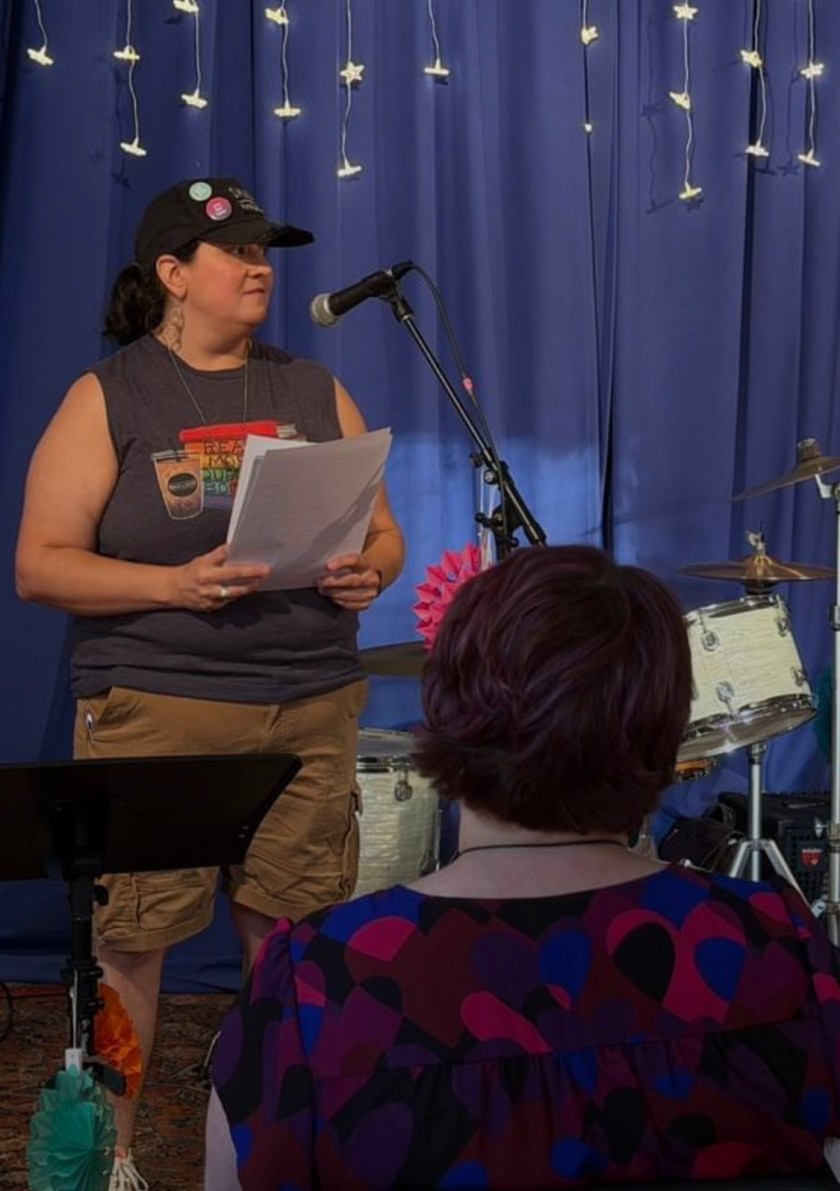
Author’s note: I wrote this for a Pride event in my town where I spoke with three other local authors. I have since edited it a bit to better suit the medium (written over spoken word).
I grew up knowing that I was adopted. I remember spending a lot of time, especially as I got into science, thinking about that whole nature versus nurture debate. I knew who I was, as much as anyone can at that age; but I knew next to nothing about my genetic lineage. I felt out of place from those first simple Punnett squares, learning about dominant and recessive genes. We had that assignment where we had to plot out a couple of physical attributes of our parents – eye color, earlobe attachment, widows peak, are the ones I remember – and determine if we had the dominant or recessive gene, and which parent it might have come from. By then, I’d already learned that “unknown – adopted” was as much of an answer as I could give sometimes.
I desperately wanted to find, and feel, connected. I knew I didn’t look like my parents, with their blue eyes and Euro-pale skin; or my sister, who had been adopted from a Hawaiian/Filipino family. I got that; I wasn’t searching for any surprise matching physical characteristics, but I also didn’t understand why I often felt so very different than the people who raised me. My mom especially would wonder aloud at me being “too much;” too emotional, too touchy-feely. I felt too deeply and took things too seriously. Now, how much of that was encoded in my genes versus how much of it was simply hitting my teenage years, who knows. But I knew that my parents, while they loved me, didn’t act like other parents I saw. It felt like they had to learn, “kids need hugs sometimes. Kids can be emotional. Kids need affection,” and not all the knowledge stuck after the exam. They hugged us, sure; when we asked for it or we had done something to make them proud. A perfunctory embrace, a quick kiss goodnight while we were young enough to be tucked in. They loved us and told us so occasionally; and they were supportive in the ways they knew how to be. Still, there was always a feeling that, while I saw friends and neighbors with their families, that our household felt more like a couple who happened to have kids.
Mind you, I’m not sitting here speaking ill of the dead. They’ve been gone for nearly fifteen years, and most of the memories I have sit silently in albums, printed on glossy 3×5 Kodak paper. They were simply not demonstrative people; it just wasn’t their nature, and I understood that, even as I ached.
Then, five years after my mom passed, I met my biological parents. Immediately I found myself wrapped in arms as tight as they could go, shoulders shaking and getting wet with tears, cheeks pressed hard against each other. Turns out, my bio parents are huggers. Within minutes I was cuddled between Kelly and Tony on the couch as we talked and talked. For the first time, I saw family resemblance; I remember the shock of meeting Tony, and seeing my reflection in him – and even more in pictures of his mother. I see that strength of physical relation with my own kid now, and I wonder if my parents (those that I grew up with) ever felt that ache, that lack of link I didn’t even know I carried. I remember the hum in my bones when Kelly squeezed my hand, as our matching mitochondria danced along the patterns in our palms. Sitting there on the couch, my mind re-drew the old Punnett squares, faded pencil marks where I could now write in pen. Tony’s eye color. Kelly’s hairline. Tony’s hair and smile. Kelly’s arching eyebrow… and her queerness.
I was 12 the first time I came out, proclaiming myself as “90% gay” since I didn’t feel like either lesbian or bisexual really captured what I knew, and queer was decades away from my lexicon. It wasn’t really something that was a life-altering Big Deal, but I did feel like it was something important people should know about me – like my black belt, my passion for writing poetry, or my obsessive interest in forensic pathology. You know, basic 12-year-old stuff. I wasn’t nervous or scared to come out; my parents had never been hostile or critical of queer people. Plus, by that time, Ellen DeGeneres was out, and my mom liked to watch the OG Queer Eye for the Straight Guy. And so, anticipating acceptance and maybe mild interest, I told my parents at dinner one night, only to have my announcement dismissed. Just a phase, they said, in the same tone that would be used to dismiss my interest in taking Honors English instead of AP. It stung, but again, didn’t feel like the biggest deal. It wasn’t the first time my feelings about something weren’t deemed important enough to be discussed further. I just figured things would change someday when I got a girlfriend, and electing to not rock the boat at the moment, I buried the ache deep inside. Then somehow I ended up dating (almost) all boys in high school and college. I always passed as a straight girl, if a bit of a tomboy – I never saw that as a threat to my identity. It was just something that wasn’t in play for me at the time. I wasn’t the only queer kid at my high school, either; there were a couple who were… well, not out (because Catholic school), but they at least lived with the closet door open. Looking back, they were not all boys, but they all got to wear pants for their school uniform, whereas I was stuck in my skirts. But it was a small gripe for me. Between my long-term boyfriend, my dedication to karate, my dying father at home, and keeping my grades up, I was busy enough that I didn’t think much about my sexuality. There were enough things to fill the void of loneliness that I couldn’t quite express.
Internalized isolation and a vague sense of something missing seemed like the best I could hope for, and even then, I counted myself lucky. Even when, at 21, I came out for a second time and my mother made her anger and disappointment well-known, I had the privilege of safety that so many others never did. I can acknowledge that, and be grateful for it – for the safety, the tolerance, the lack of violence if not vitriol. I can, and. I also acknowledge that my nature was not nurtured.
That didn’t happen until I went to Pride for the first time when I was 22. I remember very little of the actual events of the day – I remember the heat, and Dykes on Bikes, and the crying. Oh, so much crying. To this day, I cry at Pride events, no matter what they are. Over the years it’s gone from “Claire Danes in Romeo and Juliet Ugly Crying” to consistent shiny, stinging eyes and the hitching laugh-sobs, but there it is. Pride is the annual baptism of my queerness in salty tears followed by celebration and camaraderie. Hugs are freely offered and accepted and held onto tight; there is nothing indifferent or stoic or reserved. Every song, every yell, every silence is equally intentional and deafening in its choice. Acceptance and tolerance are pale shadows next to affirmation and celebration.
There is nothing like queer community. The amorphous body and innumerable facets reflect my truth and pull me inside to where I am held, I am celebrated; where I am nurtured.
Last month I left a job at an organization that cowered in fear when this administration took hold last January. The preemptive action to remove the center’s dedication to queer and trans affirming care was made under the cover of night; the tiny rainbow icons that designated providers who worked with LGBTQIA+ patients were disappeared, and the whole website was scrubbed clean of association. Flyers that had shown a progressive pride flag and large text that stated, you are welcome here, vanished, only to be replaced with flat ombre green stripes that just said, “All are welcome.” It was not the only reason I left that organization, but being so easily devalued was definitely one of them.
Do you know how many folks in our community find jobs in healthcare, or other caretaking and service fields? I don’t have numbers, but I look around my workplace – former and my new one, too – and my shoulders relax, knowing I’m not alone.
That is not an accident.
In the first week of my new job, I overheard someone saying that they believe in equal rights, not just gay rights and they didn’t understand why Pride had to be the way it was, “full of naked people dancing and lewd behavior.” That wasn’t going to do anything about rights.
Equal rights. All are welcome. Sounds a bit like “all lives matter,” doesn’t it? Dismissive, disingenuous. When I hear that, the translator in my head is already running. Decoded, I hear that my identity doesn’t matter. Who I am, what I’ve experienced, isn’t important.
And when I hear that… well, that’s my cue.
Already, by that first in office day, I had made my new email signature, complete with pronouns and rainbow stripe. I had already affixed the rainbow pin to my badge, and the one that says, you are safe with me. I was signed up for an equity training and had emailed the person in charge that I’d like to join the organization in the Pride parade.
Good thing I can be louder, though.
Rather than address this person (whom, mind you, I did not know from LaGanja), I struck up a conversation with my coworker who shares a cubicle wall with them. I complimented her Pride swag, and she showed me pictures from last year’s parade. She said that Pride was definitely a big deal around here, and I, not too quietly, said, “are you sure about that?” She chattered on about it while the air behind her went very, very still. When my fun new coworker paused for a breath, I thanked her for making sure “ally” was a verb, and told her I was glad to be working with her, here and now.
Because I cannot be quiet about it. I’ve long recognized my safety and my privilege in this world, and when I can use that as any sort of soapbox, I will. “Equal rights” and “All are welcome” and “All lives matter” are not the invitation they try to be, and are a bullshit replacement so that people who haven’t been othered their whole lives can still feel comfortable. Fuck that noise.
I grew up missing something I didn’t even know existed – a community. One that invited me in – that held meup, cried with me, shared in my laughter, and supported my family. One that flies a colorful flag that isn’t afraid to change and update and learn and progress.
That flag is a beacon. It is a coming home song, and a war cry in equal measure. It’s the flag that flew outside the church the day I married my wife, on our paperwork the days our children were born, and at least a dozen places around the house on the day my wife left this plane. It’s the one that my child knows represents safety – they know that if they get lost in a crowd and can’t find me, they find someone wearing a rainbow to help them find their mom. It’s one I wear that tells people something important, something I need them to know about me – like my third-degree black belt, my passion for writing, or my obsessive interest in ornithology – you know, basic 40-year-old stuff.
I’m still a lot – emotional, touch-feely. I feel things deeply and take some things too seriously. But I try every day to leave that sense of “too much” back with the loneliness and yearning for community. Now I wear that flag, that beacon, as loudly as I can. Because I don’t want my child, or yours, or any person at all, to feel like loneliness and indifference is the better end of violence and hostility, that it’s the least-painful outcome and the best they can hope for. Because queer and trans kids need to see queer and trans adults, to know that we survive, we persevere. That our natures are valid and worthy, and we are all deserving of nurturing. Because when the 16-year-old in the locker room sees my water bottle that says “hydrate or die straight,” tells me they like my sticker, my translator is already running. I hear words that might be hidden under them. I know what that might decode to. And when I reply, “terrifying fate, isn’t it?” it’s a reminder that just because I’m wearing black doesn’t mean there’s not a rainbow flag waving there.
There was a lot going on in my teen years. I don’t know what may have been different, had I had any representation of queer adults outside of a TV screen. I didn’t know the words to describe what I was searching for, or why I felt guilty about it, let alone what to expect, or how to prepare for a life that would never match the other 98% of TV my mom watched.
Would I have felt less alone if I’d seen masc-presenting black belt? Or a chief medical officer with a framed photo of him and his husband? Would I feel the need to make absolutely sure my queerness is known in job interviews, or hiring a babysitter? Would I have embraced the need to keep my rainbow borders up on Zoom and Teams meetings all year round?
I don’t know.
I do know that I am standing here, preaching to the proverbial choir. There is no point in this blog (or life) where I masquerade as straight. You are all here in full knowledge that this is a pride space, year round; you don’t need me to tell you the importance of a queer community. You are in it, right here and now. You have borne witness to the loud, the quiet, and even the silent trauma we continue to face. You’re here, with your stories. Your celebrations and your suffering. You have nurtured me. You have held me, and continue to. You hold my Dangerous child, and we’re here to hold you right back, just as tight.
Thank you, and happy Pride.

