I miss Hawthorne maybe the most on Election Day. Voting has always been a family affair, and it hurts that they aren’t here to take Lucy to the polls with me.
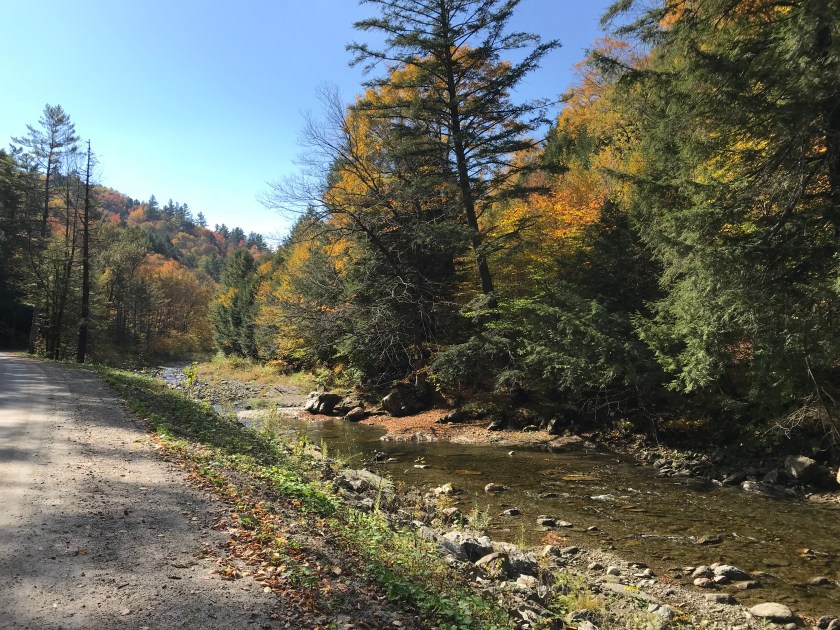
It’s a stunningly gorgeous day; it’s already 63 degrees, sunny, with pretty wisps of clouds that don’t create any shade, and fluttering cascades of orange and gold with every breeze. It feels too beautiful for things to go wrong today.
But the leaves that are left on the trees tremble, and the mid-morning shadows are deep. Schools are closed to students and open to registered voters, and the roads feel strangely empty. My mind darts wildly from work tasks to what feels like imminent violence to wondering if this is the last election.
Shit’s scary, and I want to escape, but that’s not possible. The internet says America is waiting for an STD test, a biopsy result. That this time is equivalent to waiting in an airport, where there are no rules and calories don’t count. They say democracy is at stake, that rule of law is questioned, that we have learned nothing from history. They’re right.
The news reports are scary – footage of invoking religious dog-whistles, targeted ads designed to cultivate fear and distrust, pundits outright inciting panic and violence.
My workplace sends out emails reminding me of the benefits of deep breathing, community, and exercising as ways to combat election stress. Shockingly, it’s not helping.
Everywhere I walk and drive, there are signs – on lawns, on billboards, on cars. Even those that support a viable candidate make my stomach clench.
I had to turn off NPR last week when they played a clip of Ben Carson warning that Christians are being persecuted for their politics, just like Trump is, but that God sees that and knows who is standing strong (I’m paraphrasing, because I refuse to look it up). I wanted to vomit.
I am physically ill over this election. I know I’m not alone in that; I have been hearing about the increase in anxiety and suicidality, in anger and violence, in people seeking help to deal with all the unexpected ways the stress is manifesting.
I have educated myself on the ballot questions, and I have cast my ballot. I cannot give any more of my attention, energy, or spoons to this – and that in and of itself is an action. I am choosing to try to distance myself from the pervasive politics, and that makes me feel guilty. I have been of the mind – as was Hawthorne – that the political is personal. When your rights have been decided by court decisions, it’s important to pay attention.
I still agree.
And.
I need to put on my oxygen mask on first. Right now, that means trying to avoid anything else to do with the election until the results come in
My kid has gone to the polls with me for every election since they were born. Their first, I embroidered RBG’s dissent collar on their black onesie – it was days before the first Covid lockdowns, Town Meeting day in Vermont. It was the only election that the three of us were able to vote together in, and Hawthorne’s last.
Eight months later, the onesie didn’t fit anymore. The babysitter and I met up at the polling location to swap kids, and I cast my vote before taking her home and getting each of us a bottle.
2021 saw us in a new home in a new state with a new polling place. We were able to walk to cast our votes, but it was too cold to go to the adjacent playground.
In 2022, the primaries were on Lucy’s first day of preschool. We walked again, jumping in the puddles the warm fall rain had left.
Last year was the first election I missed. My mental health was terrible; it was all I could do to keep things together, let alone leave the house after getting home from work. Lucy was enamored with watching Frozen II and didn’t understand why I was weeping on the couch from both guilt and inertia.
We also missed the primaries this year, because I had been in the hospital just the day before with a significant issue, and I was out of commission. I honestly don’t think I thought about it, but my memory of March 2024 is mostly nonexistent.
But we went back this fall.
It was after work, and I was running late for some reason. My friend picked up the kids from their school and we met up at a playground so she could run in and cast her vote, before I took Lucy across town to do the same. We talked about what was for dinner and what we were doing first. It was the first time my kid has been old enough/verbal enough to really engage in a conversation about elections and voting, and they were much more interested in if I had fresh dill (aka “the spiky leaves”) for the salmon we were going to eat. I hadn’t, and was told, “well maybe you should think about that next time, Mama.” (No, I have no idea where they get their attitude from.)
Now here we are, on a day that feels like the tipping point, and I don’t have any confidence in what tomorrow will look like. I’ve had my plan to vote, and my aftercare plan for tonight, for several weeks.
Even though we were starting our day at the dentist, this morning my kid had a million questions about why we had to go vote before I took them to school. They just had a birthday, so I’m truly living “explain like I’m 5” these days. I said voting is one of the most important chores a grown-up has; it’s when we choose the people to make decisions for our town, state, and country, and when we get to agree or disagree with changing certain rules. We talked about “little d democracy” from the book “A is for Activist,” and I hoped we will still have one by time our library books are due.
We had to take the highway between the dentist’s office and the polling place. We passed under a bridge where Trump supporters waved flags and held up signs about protecting children and Jesus is their Lord, but Trump is their president. There were uniformed officers standing with them; road safety did not seem to be the reason, and there was not enough of a crowd to warrant control.
I was reminded of something my friend had recently said: I’ve managed to hide my dislike of spiders so much so that my kid becomes friends with the creatures, but I’m not nearly so good at hiding my distrust of police. In a group chat with others just this morning, a friend raised concern when her 5 year old said that he hated those guys standing on the corner supporting Trump.
There’s a hard line to walk with kids. We don’t want to teach them to hate in any sort of blanket approach; we also don’t want to teach them to fear that way, either. But the kids in my extended village also have lessons to learn that some kids don’t. Our kids are black and brown and queer and trans and neurodiverse. They are going to learn, someday, that they aren’t wanted everywhere, that they aren’t safe everywhere. There are people who will hate them on sight, and we have to teach them to not respond in kind. There are people who wish violence on them, don’t think they should have rights, or even exist; and we have to teach them to protect themselves and those rights. We have to teach them that not only “of course your existence is valid and matters,” we have to figure out how to teach them that “yeah, the ones that hate you and don’t even know you? Their existence is valid and matters, too.”
Obey the uniforms, even if they don’t follow the same rules.
Protect yourself, but don’t retaliate.
The world isn’t fair, but you should treat people fairly.
It’s not “live and let live,” it’s “try to survive, and let live.”
The world is scary, and I’m not sure what this election will bring, and I’m not sure what I am more immediately scared of – four more years of Trump, or what a Trump loss will incite. Either way, I believe we are looking at more violence and discord and a very uncertain future.
It’s a warm sunny day in November, and I am a terrified voter.
It’s been four years since they died, because time is both nonsense and inescapable.
Four years. The memories come in italics now; softer around the edges, less of a bloodied scalpel excising moments to peer at under the microscope, watching the grief-heavy wounds lay open. They weave in and out of ordinary moments like sutures stitching past to present; I rarely flinch at the piercing anymore. The big days, though – the anniversaries, the birthdays – those still make the scars throb in remembrance.
Four years since I was held in their strong arms, since I whispered I loved them and kissed their forehead. Four years since I rubbed my fingers over their baby duck hair, newly buzzed; four years since they could laugh with delight. I think of all that laughter silenced, all those stories that died with them. They are by no means the origin story of my own writing, but on my dark days, I am reminded of all the stories I carry – Hawthorne’s and Oscar’s and my parents and father-in-law – that may also, one day, die unwritten.
Recently I’ve been frustrated with writing, having trouble with the final edits and the publishing aspect of finishing my current book. Someone close to me, unafraid to ask hard questions in hard moments, reminded me that I have Hawthorne’s stories to finish, too – and my own. The combined taste of frustration and “I love you” is familiar, one we share between us over Hawthorne, who introduced us. I’m forever grateful.
And so, I woke up this morning to write, the still-full moon hanging in my window. It is Mabon, when the days and nights are cleaved in two, a changing of the seasons that heralds the rise of the Holly King. There was a partial lunar eclipse last night, and I felt both the weight of memory and the breeze of Hawthorne’s laughter as I watched the little bite disappear. Hawthorne had been adamant about charging our crystals during a lunar eclipse just before their birthday in their last summer, and so we laid them out on the windowsill at the top of the stairs. On nights like that, with the moon full and glowing, we spoke smugly of the lack of light from streetlamps and local businesses. We reveled in the quiet and dark of our mountain, scoffing at our days in the city, so clearly behind us now. We were never leaving this place where we didn’t have to play “were those gunshots or fireworks?” during the summer (they were gunshots) and there were no neon or LED lights to interfere with the moon.
When the pain from their last surgery didn’t fade, and they struggled to hold on to hope, they cursed themselves for trying to charge the crystals during an eclipse and vowed to never do that again. I’ve kept that vow for them, though mostly unintentionally.
I often wonder if Hawthorne had lived, and been somehow left unchecked, if they would have become a hoarder. They were a collector, a maximalist, someone who could fill an empty space in haphazard form and sit happily in the chaos (until they needed to find their inhaler). When we cleaned, I could hand them a shoebox or a junk drawer full of random, stuffed-in things, and that would keep them occupied for the three hours it took me to clear out six totes old clothes and switch the summer and winter wardrobes. They’d tell me stories that the items represented, or reminded them of, or had absolutely no discernible connection to anyone but themselves – and only in that moment. The thread between the item and stories sometimes never revealed itself again.
I’ll admit it took years for me to get comfortable with this dichotomy of tidying. I know I look back with far more fondness than I felt most of the time. I would be able to empty boxes (for a while, it felt like we were always moving to a new place) and find new homes for things I wasn’t allowed to throw away at a comparatively ridiculous rate while they sprawled on the bed, a box of treasures spread before them. This would happen, too, when we were just tidying the house. One day I removed a small bowl (meant for food) from the windowsill to cries of “no, don’t, I was saving that!” only to look in it and see an empty stem of grapes, a small rock, a guitar pick, and some pistachio shells.
“Why, muppet?” I asked, showing them the bowl.
They peered in and shrugged, their signature sound for “I don’t know” sitting in the air between us until their peal of laughter as they looked up and caught my eye. I threw the contents into the trash bag, squealing “Noooo! Grapey! Rocky! Shelly!” as they laughed harder, tears gathering in their eyes. “P-p-p-picky! Not Picky!” By this time, they were on the floor giggling uncontrollably, braced against the chair they’d been sitting in. I shook my head and put the dish in the sink.
I miss their laugh. I miss their stories, and their music.
Dawn is breaking now, the tallest trees burning with color as pink clouds streak slowly across the sky. Most of the leaves are still deeply green here, but I remember that morning in Vermont. The world was turning gold and amber around us, the remaining greens poised to flame into vibrant yellows and reds. The sun sparkled on the dewy grass, the not-quite frost sliding off at the first rays of light. The sky was sharp and blue, horse-tail clouds distant and starkly white. By the time I stepped outside, there were no other cars in the driveway, those of the first responders pulled over on the side of the road instead. Lucy sat in her stroller, entertaining the half-circle of volunteer firefighters who watched her. The men stood far enough away to be able to claim “not it” for a dirty diaper, and close enough that they would get anything she dropped. She babbled and laughed, and that moment crystallized in my mind.
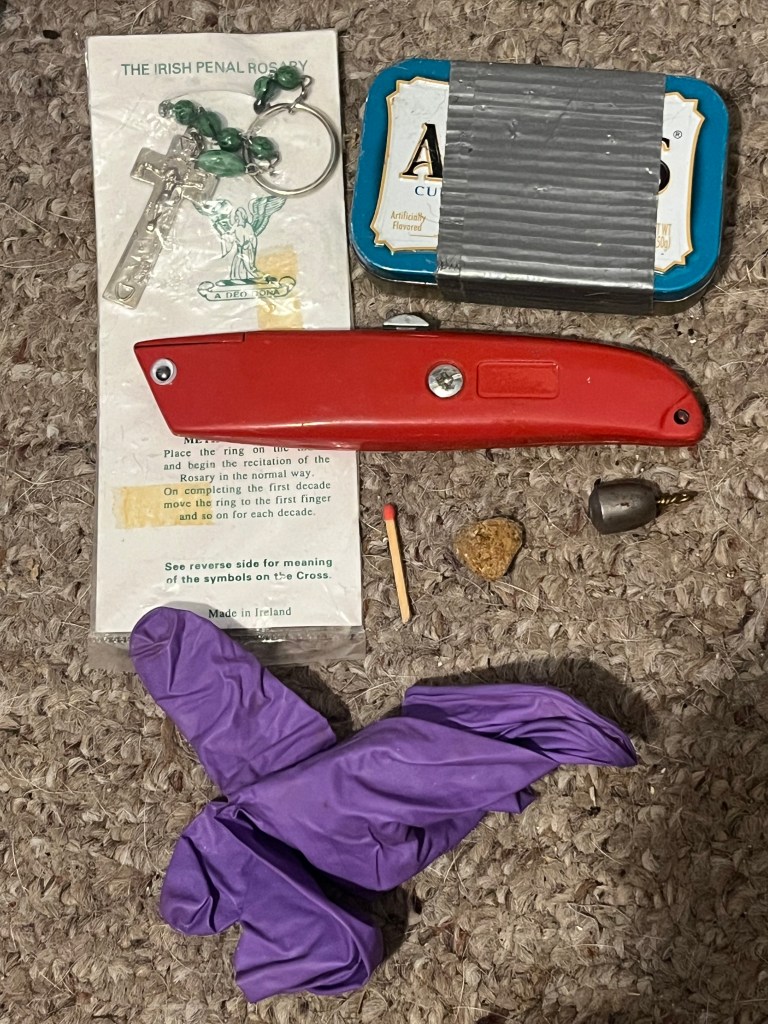
Recently I (finally) cleaned out the toolboxes. I had been meaning to for years, just one of those projects that is always somewhere in the back of my mind (untangling the clump of broken necklaces, hanging up my hats, scrubbing the walls along the stairs where I spilled coffee about knee-height). I put my music on and emptied it, wrench by hammer by screwdriver. I grouped them, then gathered the random hardware – the screws and loose zip ties and washers to who-knows-what. When that was done, I looked back inside; what was left behind could be read like tea leaves.
Hawthorne would have had a field day about this collection here. It would have resulted in hours of stories and laughter, and too many beers. It’s fascinating to me how a handful of random shit could representatively encapsulate them, or at least, the version of them they brought to a shared space with hammers and drill bits. I swear I could create a miniature museum dedicated to my wife, and everything pictured here would be in it, tokens from seasons and phases of their life. They would remind me where the rosary came from that they couldn’t just throw away. They’d talk about JPUSA, and the beautiful girl they fell in love with before being shunned. We would remember EMS stories together, the good and the bad, and the silly flogger they made with a nasal cannula, gloves, and medical tape. They would swim the shark (box cutter) through the air and make up a little song, if Baby Shark hadn’t come out yet. They’d call Ella over, all high-pitched and hysterical, and explain to her that she could not eat this old-ass piece of dog food, but it was OK, they’d go get her a treat (ella had been sleeping until this point). They’d defend keeping a stray match, and they’d want to leave the half-finished toolbox and take the weight and go fishing (we didn’t use weights). They would ask the shark (again, box cutter) to chomp open the Altoids tin, because they couldn’t remember if it was an emergency fishing kit or emergency fire starter kit; clearly it had to be one or the other, as indicated by the stray match and fishing weight. At some point they would have dropped the (BOX CUTTER) and screamed “AH! SWIM AWAY! I DROPPED THE SHARK!”
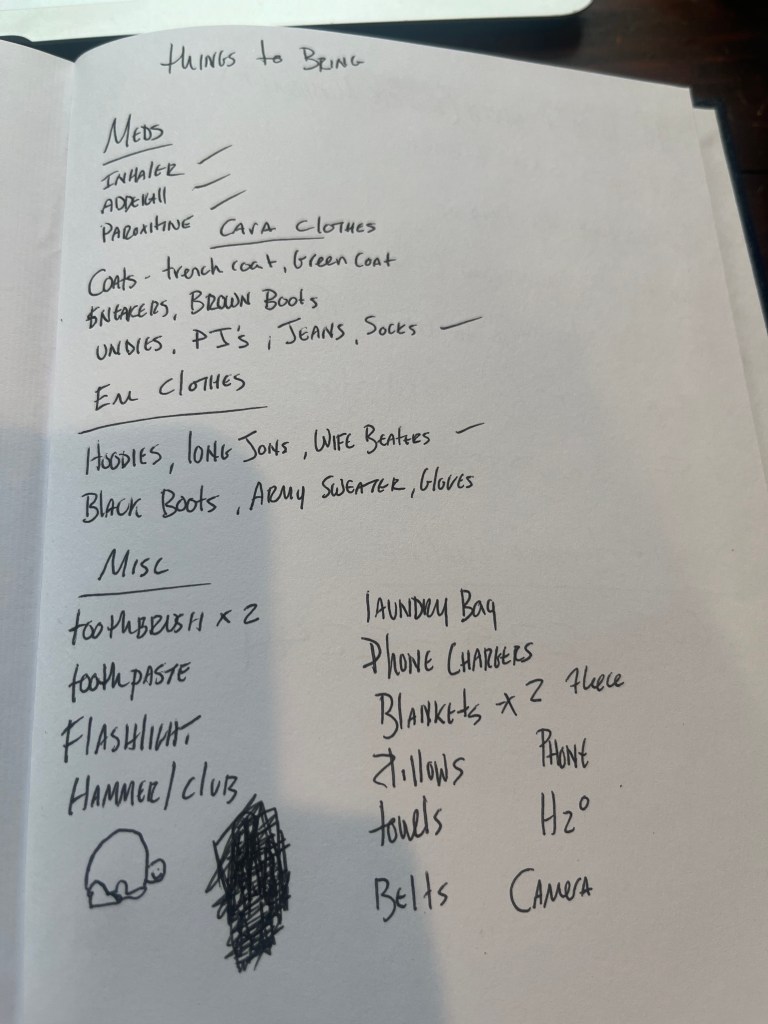
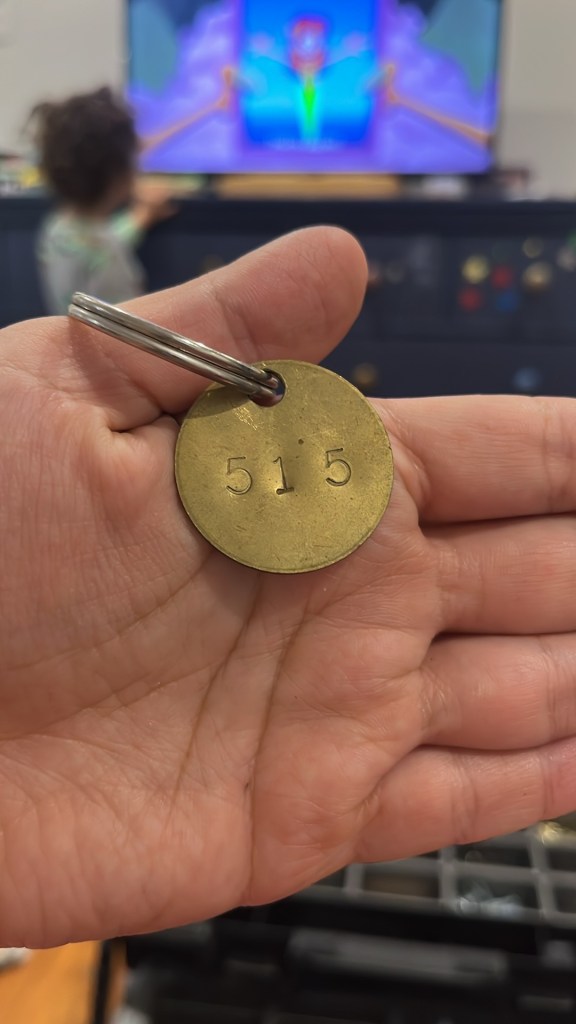
Elsewhere in the house, I still have the drivers’ licenses of two other people that were not me or Hawthorne. There are countless keys and pieces of bike locks that don’t go together. There are lists and half-filled notebooks with turtles and absolutely no concept of how to chemically write H2O.
In which strand of the thread did they live? I want to find the one where Hawthorne woke up without the blinding pain, without the need for 90-proof medicine in plastic handles. I want the one where we went to couple’s therapy and figured out shit out, and bought a place in the mountains to raise our feral child and sheep and chickens. I want the one where I finally got them on a plane, where we went fishing in Alaska, where we vacationed once in Trinidad. I want the one where they never fell down the stairs, where the medical system believed them and treated them appropriately, where they didn’t lose their wedding ring in the river.
I want the one where our memories come back in bold, in large font, in a Spread Eagle Feminist shirt and fist raised. I want the mornings of serving them coffee and first breakfast while they played guitar, eager for the People’s Jam and Heather’s bagels.
I want them to know their kid loves fresh dill on salmon and barely eats bread. I want them to know the laughter of their kid is just as raucous and infectious as theirs, but with less albuterol and more lung power. I want these things that will never happen.
The ink has long since faded from the receipts in their wallet, the thin paper blank and smooth. There are still moments, hours, days that I am angry, days where grief strips me raw so I can do no more than scream at the sea. And it’s okay. I’m not fighting them or trying to get rid of them. They come, and they go.
I’ll take the memories I get and keep them, become the hoarder of their tokens and their left-behinds. I’ll tell their stories, and let their old guitar be played. I have kept the notes and given away the books. I’ve bundled the zip ties and let go of duplicate tools. I’ve kept the pictures and trashed the hat box. I am down to a single box of nostalgia clothes, tucked away in the closet, and I wear their socks in the winter. I might hoard these moments, but I will continue to curate the collection, and let go what no longer brings forward the immeasurable love that we shared.
And fuck knows I’ll be finding these in random places until the day I die.
I miss you, in this place that looks like home. I wouldn’t give up my solo time here – it was needed – but I was silly to forget that it’s here in the mountains and fields that I find you.
Through the window of this bus, I can see the cat o’ nine tails that fill the low-lying edge of the next property, and little bunnies dash from the thicket of untamed raspberry bushes between us. Beyond that are the low stone walls that we traced years of journeys on around New England, a hazy field with a few black cattle, and the forest beyond that, rising off into the distance. More birds than you’d care to hear about flit around, but you’d be sitting with your camera, cursing my bird facts as you took me pictures of my favored bluebirds. “UNSUBSCRIBE!” You’d shout when you finally had the shot and could make noise again.
You would have slept on the outside of the bed that took up the whole end of the bus because you were claustrophobic, and been worried about biffing it on the tiny stool that was definitely necessary to climb in. I can hear you guffaw at it being sturdy enough to hold you up, then giggling as you pranced up the tiny steps. You would have touched everything, and wanted me to stitch a couch like this one. You would have teased me for how much I loved it, for the style and the demands it made to be fainted upon.
You would have wanted to break into the tiny shack, with its short door and little window, except you would have wanted me to do it, because spiders. You would insist on peeing outside instead of the dedicated porta potty – until your morning coffee hit and you grabbed your phone to keep you distracted. Because spiders.
You would have been delighted with the spotted frog that claimed the path when the rain fell. You would have laughed too hard to be helpful watching me try to get the fan into the window the first night, dropping it out twice. You’d have loved the sound of the thunderstorm that rolled through the valley, beating on the roof of the bus like it used to on our metal roof.
We’d have talked about how much it reminded us of home, of those first months in Vermont, where it was too hot to stay inside, and we cooled our beer in the river as we made our grand plans. We’d have whole days where we didn’t leave the property and spoke to no one but each other, and been perfectly content.
I wrote my own tarot pull yesterday, out here in the clear air and setting sun. The second question I had was, what didn’t I know I needed to fill my cup on this trip? I pulled the 5 of Cups, a card of grief. I thought it odd; the whole pull seemed odd, truly, and I tried to remain open to the possibilities since the trip wasn’t over yet.
This morning I woke up with songs in my head – you know what that’s like. So I set up a Youtube playlist for myself as I got ready for the trip home and onward to my event. When “Give Heaven Some Hell” came on, which I had added as an afterthought, I sang along (loudly, as I had been all morning) until my voice broke. I cleared my throat, and tried again, and the tears started.
I don’t believe in heaven, but you did.
You didn’t like country music, but I do.
So here, where the pastoral view meets the forest, the Five of Cups suddenly makes sense.
Songs like Give Heaven some Hell help me sometimes, pulling the tears out in safe places where I can cleanse myself of the grief for a few minutes. What I didn’t know I needed to fill my cup was giving myself the space to miss you, to grieve for you, since your dumb ass up and died on me almost four years ago.
I don’t know how many times I played the song, adding Where the Wild Things Are and I Hold On after that. I cried; I sobbed myself empty sitting here at the desk, your motorcycle dreams and your love for me wrapping me like your arms used to. When I was finally out of tears, I walked outside and pulled you back into my lungs, breathing in the clean mountain air until I could function.
There are phoebes here, remember the nest on our porch for years? They say hi, and they miss you too.
I’m half-packed, the bus is damp and getting warmer since I already took the fans out (I didn’t drop them this time). I haven’t finished what I needed to do this morning because I had to stop and write to you. I’m going to see Dierks Bentley this week, who you teased me endlessly about – and I’m going with one of your (our, my) best friends. We’re going to get a little tipsy, a little high, and sing along really loud and really queer. We have lawn seats; I hope it rains and we dance across the muddy grass. We’ll both feel you roll your eyes and hear your snark, and we’ll laugh and flip you off.
I want to write about tonight but it is late and I am tired. I want to write about Stonewall, about the cop car that sat there and I wanted a brick to throw for Stormé and Marsha and Sylvia. I want to write about the silver fox I met at the bar, who first captivated me with her existence, then her words, and finally her embrace. I want to write about standing inside The Stonewall Inn, absorbing the history of the iconic place, and meeting Max and Amy and Ronnie while I drank a Manhattan, not because of the city we are in, but because it was Hawthorne’s drink and I am standing in The fucking Stonewall Inn. I want to capture the fierce pride I feel, the depth of grief and despair I feel for our elders and ancestors in the community, for the hope and resilience I feel in the rebuilt bricks and boards around me. I want to write about coming here to New York, away from my child, away from my responsibilities, to recharge and rest and read and write. I want to write about all of this, and I will.
For now, though, I am still more than tipsy from the bourbon, whatever it was that the bartender poured. I’m still high on the strong hug from an attractive woman at the bar, the one who toasted my wife with me when she heard the news. I’m still soaring on the time I get with a close friend who lives too far away, the simple peace that her presence brings with her utter lack of bullshit and unwavering acceptance.
I vibrate with the movement of the subway underneath us, the boards of this apartment creaking as they shift under my feet, wide enough to feel the space between them with a single footstep. I hum along with the dull cacophony of Alphabet City, the moan of lovers behind the surrounding windows, and the coo of pigeons tucked among the crevices of the concrete.
I can’t help but absorb.
The AirBNB my friend found is incredible. It’s like living in a thrift store that was curated with the love and attention of prop masters who have lived in various countries for over a hundred years, and never leaving empty-handed, but always with a deference to the history and solemnity of the items they took with them. Nothing in here feels forced or removed. It feels like a home, more than any rental I’ve been in. This apartment – the furniture, the copious oil paintings, the myriad of knickknacks, tchotchkes, and keepsakes – this is a den of passion and love for art and travel and love itself. There is nothing duplicated here; there is nothing mass produced aside from the garbage cans and what we bring with us. One urn is filled with canes of different heights and handles, one cabinet with salt and pepper shakers. The hats might not match the collection of hat boxes, but they exist harmoniously. The Tiffany lamp with its embedded peacock and cast grape leaves, the busts of iron and plaster and marble, the stacks of vintage suitcases and steamer trunks that tower to the high ceilings; all of it, a labor of love and devotion and joy in the evolution of beauty through over two dozen decades.
I am here to rest and relax, enjoy the company of my friend and experience what I never thought I would in New York City.
I have been struggling lately – we are about 80% unpacked, hitting that spot where the motivation runs out and it’s hard to figure out where Random Thing, Exhibit G is supposed to fit into our new lives. It must, somewhere; right? We packed it up, thinking it important enough to take with us, so it must be so.
I have been yearning, deeply, since recovering from my health scare. Having your mortality breathing down your neck like that can have that affect, I’ve heard. I am desperate to be held and touched, and keening to spend my time devoted to the craft and practice of writing.
I had an author event last weekend, and two wonderful friends joined me to help me sell my book. I almost hit my goal of 15 copies, selling thirteen – and sort of considering the goal hit anyway, as at least two people promised to buy the electronic version to suit their needs better. I felt alive there in a way that felt familiar but still sparkled with new energy.
But I have been out of sorts since leaving the event, carefully packing away my author self and slipping back into the heavy – if comfortable – body of myself as mother, employee, and exhausted. It wasn’t until this week’s therapy session that I realized why it felt like I had gone from feeling so good, so high, to bleeding from my lip as I lay facedown after falling.
This is the time of year I DO devote myself more to writing. It’s when I take my annual retreat – a handful of days away from my kiddo, away from chores and responsibility and adulting, and take myself out into the world in order to focus inward. I’ve been jonesing for it, my body remembering that it’s time to get away even when my brain needed a lot longer to catch up.
Thankfully, this trip was already planned. It was supposed to be a reading retreat – books and tea and snacks, and a few excursions, from somewhere beautiful and unfamiliar. Something to break through the ruts that a hard winter bore down in us, a reminder that we don’t need to stay stuck. We can do more than exist, more than survive, more than tune out and follow where our feet are already pointing.
It’s become so much more than that.
I am reading – currently, an anthology of Indigenous dark fiction (it’s terrifying and immersive, and I highly recommend it). I’m also writing – I’ve added a couple thousand words to my latest book on this trip so far, and I’m only halfway through (both the book and the trip, so, plenty of space). I am resting, I am relaxing and rejuvenating. What I wasn’t counting on was the combination of comfort and inspiration.
The way the light comes through the windows in the morning in a way I’ve never seen before, the Persian rugs that remind me of my childhood home. The paintings and piano that stood in my mother’s living room next to blankets made from southwest sunsets and parasol collections to rival any cottagecore Pinterest board. These are collections, not clutter, and arranged in a way that make this a home, that invite the visitor to sink into the velvet couch cushions and allow themselves to drift.
This makes me feel, somehow, like my dreams are still there, still waiting, still possible. From the little ones of having a space for my tarot cards that doesn’t end up full of other stuff, to spending more time and energy banging away at a keyboard in the enjoyment of writing. In a few days I’ll return home to chaos, but this trip has been a much-needed reminder – I can have this. I can create this sense of home and peace and joy, I can prioritize my home and my peace and my joy.
My friend bought flowers for the apartment her first day here. The tulips are overblown now, stems elongated and the blooms reaching all around like a slow-motion firework. In looking up this place and its history, she decided that the person who curated this amazing place was definitely the kind of person to have fresh flowers here at all times, and she was right. Before I leave, I am going to buy another bunch or two from one of the vendors who use them to color the street side of their open market. I want to give to this experience, even though I know I am taking far more away than I could ever hope to repay.
This certainly isn’t the first time I’ve had to go away to come home to myself. Maybe it’s because this winter was insipid and hellacious by turns, and I’m just burned out. Maybe it’s because those gray days are ending, and I’m simply ready for the color to come back. Maybe I’m just finally fully accepting that the dreams I had, when it included H and Oscar and a homestead in Vermont… those dreams are gone. And, that’s OK. Our family looks different now. Shit, I look different now, and I’m still working on coming to terms with that.
Dreams change, but that doesn’t mean I can’t still follow them. And with a stop on the way including a best friend, a stack of books, and a gorgeous escape in the East Village, I’m ready to see what happens next.
I just opened six new documents in my haste to start writing this. It’s been ages since I felt like I could sit down with the intent to write and the ability to do so, but my therapist reminded me to write from where I’m at, so, there it be.
It’s been a hell of a start to 2024. I’ve had a major health scare, some new diagnoses, a rough medication taper and subsequent change that has absolutely leveled me (stay tuned, more to come on all that another time) and on top of all that, I’m in the midst of moving.
I wasn’t looking for a new place; I haven’t been unhappy where we are, in fact, I was rather content with everything except the commute time to work and other things. I haven’t been able to build the community I want here, so I knew it wasn’t forever, but it was good enough for now. But then a good friend told me about an apartment opening up in her town with an excellent school system and extremely reasonable rent. Over the next few weeks, piece by piece fell into place, and now the second quarter of 2024 will dawn in a new home.
Now, one of the most daunting aspects of moving is packing, and while I’ve managed to reduce the amount of stuff I own, I’m no exception… especially because I’m (not-so-)secretly just three little book goblins with DSM-V diagnoses in a trench coat. Every time Hawthorne and I moved, the two things that everyone who helped us – paid professionals or paid-in-pizza friends – were the sheer amount of books and guitars. Oh, and the heavy boxes clearly labeled “rocks.”
I honestly don’t remember much about my last move; packing and moving away from Vermont was an undertaking that I know I had an immense amount of help with, and very little memory of. The newness of the grief was too encompassing for me to hold those memories. I know a ton of folks stepped up, and while I might not remember everyone by name, I’m forever grateful.
This time, however, I am fully in it. I am packing, and I’m ready to go through things that I know were simply just transported before. To do this, I have been leaning on my friends, and they have been instrumental in letting me process through my emotions with them. I am no longer overwhelmed by the absence of Hawthorne, and don’t feel compelled to keep every pair of socks they wore, every book they bought, or every item they touched. There are still many, many things I’m not ready to look at – our wedding planning, their notebooks, old family pictures – but I am now comfortable letting go of a lot more than I was in those first weeks after they died.
Hawthorne and I had never shied away from talking about deaths, in particular, theirs. They didn’t expect to make it to thirty, and when they did, they spent their remaining years rather shocked that they had. We both had suffered significant personal losses before we met, and since we had met in EMS and had witnessed the cruelty of both the universe and people, there wasn’t much taboo about death for us. I remain eternally grateful for all those conversations, as morbid as they might have been from the outside. I knew their wishes and beliefs, and it has brought me so much comfort over the past few years knowing their death was not intentional. I knew who was supposed to get certain guitars, and I knew to look through any books carefully before donating them.
If we were ever to get rid of a book, we had to page through it carefully first, and make sure there was nothing inside it we didn’t want to keep. It might be a dried flower or four-leaf clover, an old picture, or, as Hawthorne would excitedly tell me, there might long-forgotten money tucked in between the pages (I have no idea where they got that one). So before I even knew for certain I was going to be moving, I began to cull the shelves. I had done a mini-clean out a couple years ago, discarding things we had multiple copies of (three copies of Khalil Gibran’s The Prophet, for example, or several bibles) or the books on Christianity that extended family had foisted on us, but it was nothing like this. I made piles in the kitchen of books I didn’t have attachment to, or want to keep, or felt like I should. It wasn’t so Marie-Kondo as to spark joy, but if I felt a connection to a book for whatever reason, or if it would be handy to have the knowledge in print (think apocalyptic scenario and I couldn’t use the internet to figure out how to pluck a chicken), it stayed. The object wasn’t to reach some percentage of less books; it was to continue letting go of things that did not serve me.
Unsurprisingly, with that mindset, most of those piles ended up being things that Hawthorne had needed for school. I certainly didn’t need eight different books on Kierkegaard, or the life works of Becker and Weber (sorry, sociologist friends). There were also some things that I remembered from my parents’ shelves that had moved house to house with me since my mom’s death a dozen years ago; I didn’t see the need for 1970’s paperbacks of Freudian theory or a 1990’s guide to local fishing.
Pulling them off the shelves was only the first steps. As books began to lean and even slide down to lay flat on the shelves, I began to feel like maybe I was getting rid of too much. Was I really going to throw away four years of education that I had been supporting? Was I really throwing away memories of conversations and stories and other unknown super important things, that my anxiety brain was trying to tell me? It was a discomfort I had to sit in for a bit. But I let myself take the time to see those shelves with a little space as opposed to jam-packed, and resisted the urge to immediately get more books to fill them. I also gave myself the space to add things back to the shelves if I decided to keep them after all (at the end of it, seven were returned to the shelves; 3 were good apocalypse books, and four were inscribed).
The piles lived in the kitchen for several days before I felt up to actually going through them and pack them into totes for donation. I knew once I started doing that, I was going to have to complete it quickly, or live in limbo with bags and bags of books in my car for who knows how long. [Quick poll, how many of you reading this have a bag of something spring-cleaning to donate in your vehicle right now?]
Finally one evening, with my sister visiting and helping out with Lucy, I was able to start.
The process itself wasn’t bad; flip through each book, checking the back and front cover an additional time. A small pile started on the counter of papers and other ephemera (spoiler alert: there was no money. I seriously don’t know where the hell Hawthorne ever got that idea). I was able to remain rather emotionally distant, since I wasn’t looking at any of that stuff yet; my focus was on getting the books out of the apartment before they got factored into packing. I got through a few stacks, and then the next morning before Lucy was awake, I finished, sitting on the floor of the kitchen with thick socks and iced coffee. I packed up the books into reusable grocery bags – seven full bags all told – and loaded them into the car. I dropped off the kid and stopped at the book donation bin on the way back from the school, and stood in a soft drizzle as I let them go, three or four at a time, into the bottom of the dumpster-sized donation bin.
The time it took for me to go through the books and send them off was just under 13 hours. The four books that remained, and the short stack of stuff I found inside the rest, has been sitting in a pile in the five weeks since. I knew I wanted to write about it, but writing itself has been a struggle; another topic for another blog post.
Now, with my six open documents, I am mid-pack; my sister has stepped in and is giving me the bossiness I need to get things done, and I swear she’s the only reason I’m going to get through this move. Today is my day to work on my desk, and I’ve got the top cleared off except for the things I need daily, a small stack of mail to handle, and the Hawthorne pile.
Once again I find myself immensely grateful for all the times we talked about this. I’m so glad it was embedded in me to go through each book, because this is such a beautiful encapsulation of my wife. The books contained:
A circulation card from a Hampshire College Library book
There’s no title or author on the card, and I wish I could remember which book it came from; I’m guessing it was something they “forgot to return” when they visited a friend at their campus.
A doctor’s appointment reminder for Tuesday, August 5, 2014 at 4:00 PM
A receipt from the Buffalo State College bookstore, paid with Financial Aid
The receipt is a good indication of the first time I heard “fucking Latour, what the fuck is this shit?”
A post-it with Stacey’s number and some doodles
I have no idea who Stacey was or is, but it’s not the Staci I know.
A $25 Lane Bryant gift cheque, valid through July 18, 2010
Two co-pay receipts from Buffalo Cardiology and Pulmonary Associates
An index card with predictions and favorites for RuPaul’s Drag Race Season 10
We had to start writing these down, because as the season went on, Hawthorne would forget who we had each picked and we’d argue about which one of us one that season; reading the names brought back such clear memories of some of the fantastic queens from that season, particularly Blair St Clair and Miss Vanjie (still, always, forever my fave)
A blank yellow index card
A blank piece of paper from a notepad that had some sort of design on the edging
A scribbled drawing of a pregnancy craving I had for chocolate-dipped candy lemon slices* on a Holiday Inn notepad
The syllabus for Introduction to Sociology (SOC 100) with Dr. Lindsey Freeman
An empty circulation card for Margaret Mead’s The Golden Age of American Anthropology
A circulation card from the Buffalo and Erie County Public Library for an unknown book, last checked out October 16, 1963
Two general admissions tickets (valued at $10.00!) to see Bob Dylan on July 18, 2013, with listed openers Wilco and My Morning Jacket
This was a fun day; some blacked-out SUVs drove past us and we were convinced they were for the unlisted opener, who was Brandi freakin’ Carlile, and the real reason we went. We only stayed for 4 songs of Bob Dylan.
A black-and-white picture of Hawthorne playing guitar in their early twenties
Their hair is a short faux-hawk, and their ears don’t appear to be gauged yet, so that’s the best guess on age. I’ve seen the other pictures from around that time and I want to say their brother was about 18, which would put Hawthorne at 21, best guess.
A page of notes from sociology class on 2/28/2013
It looks like they had forgotten their notebook and borrowed a sheet of paper from someone else. Based on the notes, this is likely one of Allen Shelton’s classes, but it could have been a different one I suppose.
A term paper for Dr. Staci Newmahr’s spring 2013 sociology class
This wasn’t the graded one, so I don’t know how they did – but I know it was lower than an A-, because they all were, much to their consternation.
An engagement picture of Hawthorne and I leaning on the fence of the posting location where we first kissed
Hawthorne’s social security number written down
This honestly baffles me, even knowing my wife. It was actually written into the blank first page of a book called The Cost of Being Christian; I just ripped the page out. Who writes their SSN down like that?? WHY?? C’mon, babe, what the hell.
Four photos printed at the one-hour photo on 9/3/2000 of someone on a corded phone with the following captions written on the back:
This was taken before you realized you had missed your train.
This was taken when you realized you had missed your time.
When you realized that you had missed your train and it was costing you money.
I didn’t understand the whole “little” things but I took a picture anyway
So I showed these to some of Hawthorne’s best friends, and no one could ID the folks in the pictures, but we did rule out a lot of people. Since I don’t know them, I’m not going to post them here.
The four (non-apocalypse) books I kept each have inscriptions, all from different people.
Destiny of the Republic, by Candice Millard
This was a Bookmas gift from 2016 and has a lovely inscription from my cousin to my wife. Our family swaps books, gifted along with chocolate, on Christmas Eve every year.
Parables of Kierkegaard, edited by Thomas C. Oden
This one has 3 names with phone numbers, an extra phone number from a Rochester area code, and a note to Hawthorne from a friend who visited while they were in the hospital for their asthma. This one also has a scrap of a note with someone else’s handwriting about neurocardiogenic syncope and a tilt-table test. The scrap looks like it was grabbed from a nurse’s station that used the back of misprinted documents, and there’s a timestamp that says 4/26/2005 – 19:30.
Hamlet by Shakespeare, a Dover Thrift Edition
This is “an average teenage girl note” with bubble-dotted i’s, written in pencil, from a friend of Hawthorne’s growing up. If it’s who I think it is, I’ve only met them once, but I cannot bring myself to let go of something from their “BFF!!”
Mere Christianity by CS Lewis
This was an interesting one. There are four lines of what sounds like a poem or a song that Hawthorne wrote down on the inside first page, under the publisher’s mark. I knew that Hawthorne had written songs, once upon a time, so at first glance I figured it was theirs. Good thing there’s Google, though, because once I really read the lines, it didn’t sound like them at all. Sure enough, the stanzas come from a book called The Singer Trilogy by Calvin Miller, which is a mythic retelling of the New Testament. Which made sense, considering the book and topic. Since I ended up handling this one more, I discovered an additional four lines on the blank back page of the book, from the same source.
I love when I find things tucked into old books that find their way into my hands. It feels like a glimpse of someone else’s story, no matter what it is. I feel like all the things I found in our books are just prompts – for memories, for writing, it doesn’t matter which. And while I’m always happy to stumble on other’s ephemera like this, I’m being true to my little book goblin self and hoarding these ones. I want to keep them for myself a little longer. I’ve thrown away the appointment reminders and the blank index cards and the receipts. The little library bits, their papers, the ticket stubs and photos – well, let’s just say when I eventually get around to making that scrapbook, I’ll have plenty of stuff that Hawthorne left to contribute. There’s a lot more to say about unfinished stories, and the threads we leave behind as we move on through apartments and lives and states of being. I’ll be picking at some of these threads another time, from another town.
*If you’re reading this far, and you noticed the asterisk, this story is for you.
So these lemon slices. Pregnant me did not have good taste. Pregnant me got sick at scent of sweetened hot coffee, and really loved the smell of Ella’s joint supplements, like, thought they smelled delicious. Anyway. I had been at a conference held at a Holiday Inn, and had used the notepad at my seat. All I could think about that morning was these candied lemon slices we had bought at Trader Joe’s after one of our appointments in Burlington, and I had been watching too much Great British Baking Show. I thought that fresh candied lemon slices, half-dipped in semi-sweet chocolate with a little abstract line design of white chocolate on it, would be the most amazing thing I’d ever tasted. Now, Hawthorne was an excellent cook, and always did love to make my dreams come true. So I had drawn this little thing to look like one of the signature challenge sketches from the show, and sent it to them. I think I also talked about it when I got home, and then promptly forgot about it by the next day (pregnancy brain was real). A few days later, I was having an angry emotional pregnancy day. I felt fat and miserable and uncomfortable and gross, and my beautiful, wonderful wife wanted to cheer me up. I’m standing at the counter crying and they tell me to close my eyes. I do, and I hear them banging around in the pantry before I feel their arms come around me and they tell me to open my mouth. I do, and they put something in my mouth. I immediately start horking it out, trying to get the offending concoction of absolute ass and garbage out of my existence. “What the FUCK was that?” I’m over here, trying to bend over the sink to run water on my tongue, and poor Hawthorne is standing there, eyes all wide, holding one of the candied lemon slices and a tub of dark chocolate frosting.
“I thought that was what you wanted! I thought you liked it! It was your craving!”
“Oh my god, my cravings are stupid.”
So yeah. They did make me feel better, though not at all how they had intended. We laughed about it every time I had another craving, like wanting to eat the dog’s medicine. We kept that little drawing, and I think it actually lived on the fridge for a while, probably until Hawthorne walked into the kitchen reading something and decided they needed a bookmark. Y’know, like you do.
The offrenda is small this year. Symbols and touchstones take the place of photographs. A tussy-mussy of marigolds snatched from the last scraggly pot at a pumpkin farm lie wilting in front of the tiny urn and crystals. The light from the small candles barely reaches to the floor before the altar. This simple and unplanned space is all I could manage this year.
It has been a rough six months, on the heels of a difficult winter.
Every time I feel like I’m turning a corner, that my mood and energy will start to improve – with this new therapist, this new medication, the hours of sunlight a day – something interrupts my anticipated progress, and I am grieving all over again.
I grieve the hours stolen from me – by the depression, by the job, by the stupid amount of time I spend driving place to place. I am grateful for the pay and the health insurance, and the meaning buried deeply in the work I do. The traffic exhausts me and by the time I arrive home, it is all I can do to empty lunch boxes and get dinner together.
I grieve the energy and patience lost to having to shoulder parenting a toddler alone. I am grateful for my village, without whom Lucy would not have had a birthday celebration or trick-or-treating on Halloween. My Target receipt would be miles longer for clothes and shoes, and I would have missed out on music and so much conversation with other adults.
I grieve for my wife, as a widow. I grieve for my son, as a loss mom. I grieve for my daughter, as any parent does, as there aren’t enough hours in the day to both function in this world and to focus on her joy and her journey.
I grieve for my friends and family who have suffered at the hands of others, even as they fight back against oppressive systems. I grieve for strangers who went bowling, for strangers who find themselves displaced and endangered as war rages in front of their eyes and ravages their families.
I know that I cannot take on the sadness of the world, and that is not my intent. Nor is it my intent today to use this platform to provide a beacon of hope or light or whatever positivity I can muster.
Because right now, even as I wait for my daughter to awake, for dear friends to arrive, even as a new exciting chapter is opening its pages – amidst the small joys, I am weighed down by everything from war to neurotransmitters. There will always be people who measure their power in the taking of human lives. The oceans are warming and the sea is still rising. My first child and my wife will still be gone from this plane. My brain will never make its serotonin quota on its own. These aren’t lamentations or intrusive thoughts; these are irreversible facts that I have to acknowledge every day.
I think we do a disservice to people suffering when we cannot acknowledge it without also providing some sort of golden thread of hope.
I’m not saying give up on hope. I’m not saying that we, collectively, should stop lighting candles or saying prayers or looking for the helpers. I’m not saying don’t continue seeking and demanding justice and ceasefires. I’m not saying little moments, gestures of kindness, or offerings of hope aren’t massively important.
I’m saying that shit’s just heavy sometimes, and the presence of heavy shouldn’t automatically trigger a response of lightness. The “equal and opposite response” law isn’t an evenly spread layer of karma that makes the balance evident. Balance in the universe doesn’t trickle down to the individual level, and we don’t need to fall into the trap of false or toxic positivity to try to make ourselves or others feel better.
So if all you can see right now is dark, I get it. I see it too. And it’s enough to acknowledge that. Whatever you can muster, in whatever season you’re in, is enough. You don’t need to look for the lesson or the silver lining. You don’t have to think your flaws are beautiful, or that blessings always wear disguises.
There will always be heavy shit, there will always be darkness, and the seasons will change. If all you can do is acknowledge that, it’s enough.
I sit here this morning, heart heavy but failing to weigh me down. I may find myself sinking later, pressing down to the floor, our songs playing and the curtains pulled. For now, I’m following what feels good, what feels fitting; and so this finds me at my favorite local café with a hot mocha, coffee cake, and classical music to cover the soft sounds of the other patrons studying. I came to write, and through that, hope to process the past weekend in a way I couldn’t while I was in it.
It’s been so long since I have written here in this space, and the years have been so full of both planned breaks and impromptu hiatus, I almost don’t remember what I’ve written. I’m not even sure I know where to start. But Sunday morning found me sitting there in the mountains that I called mine for nearly six years, and I felt more at peace and at home than I have in a long time.
It was almost the anniversary: almost three years to the day since Hawthorne died, and this stopped feeling like home. At least, I thought it did. The immediate loss and grief, the overwhelming urge to run away is not forgotten. Neither, though, was the slide of my shoulder blades down my back as the mountains came into view on I-89. The folds in the rolling fabric of trees that covered them, growing shabby as summer so quickly faded, blanketed me with warm welcome.
I was visiting with dear friends, a trip that got postponed from a summer of illness followed by Covid last year. Lucy was there, of course, and nearly twice as tall as when we left. The magic within her is likewise sparked by the return. She’s asked to watch TV a couple times but is mostly content to play with one of us, read her books, and plow through the donuts she asks for. Plus, I’ve told her that the TV isn’t working, just like every AirBnB we have stayed in. An unfortunate coincidence, should she ever call me on it (and one day, she will — she’s not yet four, and has already asked if it is plugged in, needs to charge, or needs new batteries).
I’ve been here twice more since the people’s jam for Hawthorne the July following their death, which was the most fitting celebration of their life I could have ever hoped for. The first was earlier this year, a random rainy Saturday in June where I let the tires point where they may, and stumbled upon a local author/book fair in the center of Woodstock. Lucy and I got maple creemees, and we took the dog and played at the river in the rain, driving all the way home stripped and wrapped in blankets with the heat on. Then just last month, another branch of my village spent two nights here, soaking in the music and the mountains. We stayed in Killington, and as the stars prick through the dark sky, I felt at home.
Those trips were lovely and I’m so glad I went both times, but now, I don’t ever want to leave.
Overnight the mountains started to dapple with color; green, still, with tints of yellow and ochre. The wind rustled leaves gone dry at the edges as the first showers of foliage began to fall. Every now and then a beech nut clanged off the metal roof above me on the covered porch, making me jump in the relative silence of the forest.
The whole weekend was magical. Friday morning, I took Lucy home, and brought our friends to see the river and the road we had called ours for almost six years. I took the backroad, turned onto the dirt road that warned against using GPS in that area. I parked just over the bridge and we walked the same path I had walked for so long, the same run that I’d taken with Lucy asleep in the stroller before the world changed under our feet. But this road was the same. The house, no longer ours, stood the same; there was evidence of updated utilities and the skeleton of a structure where the woodpile had been, likely for the same purpose. The grass had been recently mowed, and the meadow looked more natural than ever.
The streams that tumbled down the mountain looked the same, and the track of the river hadn’t changed much. It sounded like home in the water, and the air tasted of it as it crossed my lips. Lucy dragged a stick around in the dirt, running to my outstretched hand as cars announced themselves far enough away for her to be safe running ahead. We walked up to my Mother tree, standing tall and proud as ever. I leaned forward and placed my hand along her bark, and felt the warm beat of recognition.
Later that day, we had a picnic in the cemetery where Hawthorne and I would walk. We all trekked up the hill, leaving the blanket (and most of Lucy’s lunch) at the bottom. I spread myself over the thick green moss and let myself sink, sink, gentle and slow. I tried to teach Lucy how to respectfully explore the graves, with gentle hands and careful feet. Most of it went unheeded, and she log-rolled away from us down the hill, laughing wildly, whenever possible.
We journeyed throughout the day, my friends exceedingly patient with multiple stops where I’d see friends and folks I hadn’t spoken with in two or three years. I continued to be shocked and humbled by how many people recognized me, and more, recognized Lucy as the little tiny potato that Hawthorne and I had so welcomed and wanted to share, only to be mostly denied by the onset of Covid.
We did all the beautiful, mundane things that made up our lives in Vermont – went to the coffee shop and bookstore, got sandwiches at the local general store, visited the library, and shopped at the little grocery store. I bought eggs and tomatoes for dinner at the farmer’s market, and sat in clean air on green grass while Lucy played and danced. I ate a whole pint of small tomatoes, the aromatic scent of their stems filling my head with memories of tilling, digging, and planting.
It was Saturday night that hangs on a string around my neck and pressed to my heart, never to be lost. We were at the Wild Fern, a pizza café that defies simple explanation. It is the heart of the magic of that corner of the world, and is fed by the rivers and the trees all around it. I had planned for this to be as beautiful as it could be, and was given more than I thought possible. I had taken some edibles a couple hours before the show, and they kicked in just in time for the ride to the Fern. Once there, once inside, I was caught between two worlds. The front view – a 180-degree semicircle that bisected my body along the coronal plane – was the present, the now, the moment. Pressed up against that, all behind me, it was a Thursday night in the late winter, with Lucy a tiny bundle being passed from person to person, the cold night outside no match for the warmth of the kitchen and the music inside. I existed there, in that liminal space between, fully present in both. If I turned quick enough, I had a flash of that night before it slipped back behind me out of view. I could see the lights and the darkness outside, I could feel Hawthorne’s hands on the small of my back or my hips. It was as real as the Saturday night I faced.
This feeling stayed with me for hours, and I sank into the comfort of it, of being deeply aware of its transience, and soaking in every moment I had. On the stage outside was Rick Redington and Tuff Luv. With three fire pits glowing and Lucy dancing for hours, the band played. Bass, guitar, and drums all seamlessly blended to evoke emotions that swirled along with the fire smoke and prompted Lucy to yell, “rock and roll!” half a million times as she played air guitar and punched her fists in the air.
The music paused for a bit, as Rick introduced the next song and from the shadows pulled out a different guitar. It was unusual; small, double-necked, and heartbreakingly familiar.
Hawthorne had found this old guitar, a bit busted and unstrung, at the local dump on a Saturday morning that we were set to return to Buffalo for a visit. They didn’t know anything about it other that it clearly needed to come home with us, as every cast off guitar they’d found before had.
But this one was different (and more, I remember writing about it here). We brought it to our local luthier (because of course, hidden in the Vermont mountains we have an incredible luthier), who took wonderful care and brought the guitar back to life. It turns out it was a custom build, a small harp guitar, most likely from the late 1800s. One neck was strung like a guitar with a fretboard, and the other side reminded me more of a viola or cello. I wasn’t the expert, that’s for sure, but Hawthorne held that guitar with the highest reverence.
When they passed, they left thirteen guitars that I suddenly had to figure out what to do with. I kept a few that I knew were intended for very specific people, and the rest went to Rick, as I knew Hawthorne would have approved. That was a bond between musicians, and the harp guitar was a natural fit.
So there, sitting around the fire with our daughter dancing, Rick and I told the story of the guitar, before he played. I’d heard him play the song before, but not like this. Not holding a piece of Hawthorne so close that I could hear them in every note. Not with the stars shining down on me and Lucy. My tears fell fast and hot, soaking into the ground as my breath sobbed out. My friend held on and let me lean even as she cried herself.
For weeks, our closest chosen family has been telling me the ways they’re feeling Hawthorne and experiencing their presence, especially with the advent of fall and the time spent in Vermont. It’s been hard to respond over the feelings of anger and jealousy that I have not felt them.
Sitting there, listening to the harp guitar sing under Rick’s skilled fingers and vocals, I felt Hawthorne’s embrace. My face pressed against the night sky, against their chest, I wept out the pain and sorrow of the years prior – the words unsaid, the “I love yous” and “where are you for this?” unanswered. My soul cried out and was soothed; my heart broken and gently held. I was wrapped with the long-ago night of music and family and Hawthorne and magic against my back, and the current moment of unimaginable community and love and love and love.
The night continued on after that, and the nights began to blur together. Lucy fell asleep in friends arms with the stage lights shining and bass line thumping, just as before. I had one of Hawthorne’s flannels to keep me warm, and we stayed until the crickets took over for the band and it was the music of the night that echoed off the mountains.
It’s daylight now, and I’m nearly two hundred miles away. It was – is – hard to come back. I look up from the computer now and then to the café around me, half expecting the music to be wafting through the trees that surround me as I feel myself back in my forest. Everyone seems blurry and little unreal, as if the café has been the image imposed over the forest and not the other way around. The image fades when I remember to remove my reading glasses, so I don’t. Let me be there, in that other world, with the industrious squirrels under the music of the fairies.
There is a melancholy in me, sorrow that has softened with time and carries gentle waves of yearning – to have Hawthorne back, to feel the warmth of their love, to return home to our mountains and their arms. And while those things will never be realized, I can easily trade any windswept moors to wander despondent for the cool forests and running rivers of Vermont.
I will make my way back there. To visit, and one day, to stay. To return to a place that gave me so many memories, so much community, and family and music and love. That time isn’t here yet – I’m still in that space where I need the distance as much as I need to know it is there. I will get there; after all, I am forever a child of the woods.
While I always was a reader (save that anomalous period in my twenties), it’s hard to remember a time when I read quite like this.
Maybe when I’ve been involved in a series; Brian Jacques’ Redwall comes to mind, as do the first five books of a most famous series involving an English wizard student. During my early teenage years, I read everything by Patricia Cornwell that I could get my hands on, about the forensic pathologist whom I hoped to emulate at the time. Prior to that it had been Lurlene McDaniel, the tragic romances of (some terminally) ill teenagers; after that it was Nora Roberts and the approximate six thousand books she’s written, as well as under her pseudonym, JD Robb. By these five authors alone I must have read somewhere between 200-300 books, and that’s not an exaggeration. This is also not to mention the everlasting Babysitter’s Club, Boxcar Children, and Judy Blume volumes that pre-dated any shred of romance or shadow of puberty. OK, so I totally read like this when I was a kid – or at least before college.
I fell in love with public health reading my assigned incoming freshman book, Mountains Beyond Mountains by Tracy Kidder. Paul Farmer remains an inspiration to this day. That’s the last book I remember before schoolwork took over. I had ideas of being an English major on the pre-med track at that time. That first semester I took two heavier reading courses, one mandatory and one for adolescent lit, which introduced me to entire worlds – the ones that stick with me are Phillip Pullman’s Dark Materials. Those books still take up residence in my soul and influence my daily thoughts, that there is something under the surface of everything we see. The next semester, however, I took a class on the American health care system, and that beckoned me on to major and get my degree in public health. Luckily, it meant I got to read a whole bunch of other books – memoirs and sociology alongside the drudgery of biochemistry. I didn’t realize that the accounts of folks living with Downs’ syndrome or paralysis would be some of the last things I would read for a decade.
The dropoff was steep; I struggled with my mental health in my senior year and ended up spending some time on an inpatient psychiatric unit. I can look back now and have compassion for the young woman who was scared and alone, both vulnerable and stubborn. After that, reading was largely missing from my life. It was a combination of the medications (which I definitely needed) and major upheavals in my life: getting married, moving to Buffalo, and knowing almost instantly that it was all a mistake that I couldn’t make right. For the first time, I was watching TV regularly. I’ve seen more CSI, NCIS, and other various cop drama than I care to remember sitting on the couch in my husband’s grandmother’s house. I was still very depressed even if I couldn’t articulate it then. Finally I transferred my EMT card and got a job with the local company on overnights. It took two semesters to finish the few credits I needed to transfer back to actually finish my degree. The year of school days and work nights pushed me to the brink of exhaustion. I’d sometimes pick up one of my Nora Roberts for a bit of comfort, but reading was something, like writing, that had largely disappeared from my life.
Later, in the early days of our relationship, Hawthorne and I didn’t exactly spend our time together turning pages. We talked about it, though, extensively. By the time they left the field to go back to school and I changed companies to be outside the city, we were an official couple. I had a brief window where I’d always have at least one paperback at the ready.
Hawthorne knew I had not been able to indulge in books and reading the way I wanted, the way we talked about doing one sunny day. They wanted me to read more than romance, which I wholeheartedly agreed with, though it has always remained my comfort food. I had felt so stymied that I was intimidated by the sheer number of possibilities of “what to read next.” I will forever be grateful to Hawthorne for gently opening the doors to whole new worlds and drew me back into this beautiful genre I hadn’t begun to explore of creative nonfiction with authors like David Sedaris and Oliver Sacks. They also introduced me (in some cases, re-introduced me) to Hemingway, to Steinbeck, to Jeanette Winterson and Annie Proulx, Truman Capote and Flannery O’Connor. As I returned to the written word, I introduced them to Lawrence Ferlinghetti and Tracy Kidder. In the four months between Hawthorne starting school and me becoming the quality manager at my ambulance company, I read ten novels, two of which – Bridges of Madison County and East of Eden – are still some of my favorites.
It was an amazing way to build a relationship, on a bedrock of literature shared and mostly enjoyed. We had some failed trials, sure; I liked Lolita, but haven’t yet tried any Dostoyevsky; they never did get through more than a couple chapters of Nora Robert, and I liked more real science than they ever did. As for the myriad of sociological authors they left behind on our shelves? There’s only a few on my TBR: Proust, Foucault, Shelton.
As I began to read more and more reports for work, I turned less to the shelves again, but never so hard as to forget their importance in my life. Even now I still have a tendency to absolutely inhale the volumes of Nora Roberts, gulping down chapter after quick chapter whenever I stumble across a new one. My mother used to buy me two of her books a year – one for my Easter basket, and one for Christmas. They never lasted a day. Now I willingly go on anticipated binges; I wait a while, cleansing my palate of formulaic cis-het, white, vanilla romance. Then I will frustrate myself trying to navigate the connection between the Kindle app and my library app to blow through four or five that have come out during my fast. I carry the Kindle to the kitchen to get fresh coffee, to the back door to let the dog out, and forget to feed myself (don’t worry, Lucy cannot be forgotten). At the end, I raise my head, utterly dazed and disoriented. It takes a couple hours for the headache to fade and my vision to clear, and few days for my neck to get back to the correct angle from being so intently bent towards the screen. (I’m rolling my shoulder out and correcting my posture now just thinking about it.)
After Oscar’s death, then Hawthorne’s, I have turned back to words. Writing them, reading them, watching my tears soak into the ink. I pushed myself through Joan Didion’s Year of Magical Thinking and thumbed the dog-eared pages of my favorite romances. When I began starting to piece my new life that I’d been given back together, I filled my shelves to bursting (they were already quite full) with self-help books with titles like Girl, Wash Your Face and You’re Not Lost. They had some good lines; there’s plenty of marginalia to go back to, but over self-help books just weren’t that helpful.
I began reading again, deliberately, in 2021. That year I started nine books and finished five. One of them, Too Like the Lightning, remains unfinished – not because it isn’t amazing, but because I rarely have the time to devote to being totally immersed into a world so different than mine. Ada Palmer’s glorious stories demand of me a minimum of two uninterrupted hours to make any progress.
In 2022, I made daily reading a habit I wanted to keep (with wavering success) and set a goal of 26 books for the year. Counting a 500-page novel draft from a friend, I hit the goal with an eclectic mix of gay romance, mainstream fiction, Brene Brown recommendations, and nonfiction books about the death of the body. There was the beta-read novel for a friend, two audiobooks, and at least 5 Nora Roberts on my Kindle.
My goal for 2023 was 30 books. I planned on pacing it out, but then someone gave me TJ Klune’s The House in the Cerulean Sea.
Since then, I have had an insatiable need to stare into the pages, my eyes racing over the text, and never feeling like it’s enough. I feel greedy, possessive; I gather these volumes to me, unable to wait for the paperback versions, needing to feel the weight in my hands. The scent of new books, old books, the dust and the ink all further whet my appetite for them. I long to be in bookstores with infinite money and infinite time, and have visited three different libraries already this year.
On my little retreat in Provincetown; I brought several books that I had started or wanted to read, a mix of poetry, fiction, and nonfiction books on writing. To no one’s utter shock and disbelief, it turns out that when I have stretches of time to myself, I still will find a comfy spot and dive into a book until something interrupts me. I finished two books I had begun prior to the retreat, and read two more completed, and started a fifth. (I also may have visited every bookstore in town and purchased an additional ten titles but that’s not the point. In fact, I should be commended that it was only ten, especially since one of them was a used bookstore.)
I thought, okay, this is a little vacation fluke. I can’t keep up this pace. I’ll fall back into my old ways and struggle to get ten minutes of reading, my little goal, in per day.
Turns out I was only partially right – I couldn’t keep up that pace, but holy crap, I am still reading more than I have in years. I’ve finished, what, three more books since returning? In three weeks? I am two books ahead of my goal per Goodreads.
I keep a new picture on my phone screen to remind me that “what you are not changing, you are choosing.” I have been trying to get off my phone for a while. It’s hard. I like the distraction, the immediate dopamine hit, and I’ve also discovered a particular animal sanctuary whom I’m a little obsessed with. But man, I do not want to be staring at that little screen as long as I do. I’ve set limits on apps – 30 minutes on Facebook, 60 on games; but I can easily make excuses to not follow the self-set rule. I find ways to circumvent it, opening things to read in my browser instead of Facebook, subtracting the Maps and Facetime minutes. Bad mental health days see the times spike; good days, where I hike or create or connect with live people, those days see the times drop. So, too, the days I spend reading – and that’s what I want.
I want to live a life where I do read voraciously, where I am spending my energies in saturating experiences like books or travel or laughing with friends. I want to be caught up in my life as I get in the lives of characters, to be focused and mindful of the story and my place in it. I want to think of seas as cerulean and feel my heart pound for fumbling first kisses. I want to remember the hum of magic just under the surface and the feeling that we are never really alone in the woods. I want to find the worms when I dig my hands into the earth, brush dandelion seeds from my daughter’s hair, and show her the world beyond these screens. It’s not easy to get away from all the distraction, but oh, it’s so worth it.
This was long and rambling. Thank you for reading. I hope you keep reading, anything you stumble across. Blogs and books and cereal boxes and bottles of shampoo in the shower. It is thrilling to me that my words can be part of your reading journey. Thank you.
We kept the celebration small this year. The kitchen table was pulled out, the basket of condiments banished to the pantry for tonight. There were 6 place settings crowded around the square table. I pulled the three chairs I owned in around in and added the stepstool; the kiddo would get a kick out of that. Lucy had her high chair, and I was happy to stand. Truth be told I was too excited to sit.
We set the table together, with silverware clattering on plates, as “Lucy Danger” and “gentle” don’t always go together. The sun had set already, and the sky was vaguely purple with the cloud cover and light pollution from the city refracted inside it. I fiddled with the vases of bright orange carnations, and bit my lip as I worried that they were not marigolds.
Suddenly, there was a rush of warmth and the voices of our beloved guests poured into the room. Lucy was startled and ran to grab my leg a moment, but found herself swept up in hugs.
Oh, but they looked wonderful. They’d all dressed up for the occasion. Stan, in his suit from the church picture that his wife had taken, shit, must be ten years ago now; Clark, a fresh flannel button down and pressed slacks, with his hat and walking stick and sunglasses. Hawthorne, dapper as could be in a lavender button down, jeans, vest, bow tie, and pocket chain. And Oscar, my sweet boy, in a checkered Oxford shirt and suspenders on his jeans.
He’s gotten so tall, a full head taller than his sister, who was looking at him with wide eyes from her perch up on Clark’s shoulders. He’d be four now; he sure seemed like it. Lucy kicked her legs and demanded “down, down please!” Clark lifted her off his shoulders and put her down, and I watched my children, my babies, run into the other room to play. Their grandfather went with them, a smile on his face that I could tell reached his eyes, even with the sunglasses.
I turned from hugging Stan, who followed in to watch his grandkids play, and found myself back in my spot, head under Hawthorne’s chin, their arms wrapped right around me. We fit perfectly together there, and always had. I breathed them in; sandalwood and calendula, and the smell of their skin that I remembered so well. I wanted to pause time, to feel those arms hold me like no one else could, to lay my head on their chest where it fit so naturally. The bossa nova station I had playing on my computer slid toward something slower, wrapping around us as if we needed help holding on to each other. We swayed in place a moment, then Hawthorne tugged my hand. I spun away and back in, laughing into their eyes. We danced in the kitchen like we had so many times before.
The kids ran in, demanding food, followed by the men. Hawthorne gave me a last squeeze and let go, reaching to pick up Lucy as I turned to the stove.
“Hey, baby. Remember me?”
Lucy nodded. “You Papa,” she said, pointing. My eyes stung, and I closed them against the wave of emotion. She was always to ask to look at pictures, and didn’t always recognize Hawthorne. “That my Mama,” she continued, the same way she told her friends at school every time I came to pick her up. “Who that?”
“That’s your brother Oscar,” Hawthorne told her.
She gasped. “My picture!” She strained to get away, and since neither of us knew what she was talking about, they set her down. She ran into her room. “Mama, my picture!”
We all followed her in, Oscar pushing through legs to get to the front to see. Hawthorne gripped my shoulder and tears filled my eyes.
She was pointing to a painting given to us by our beautiful and talented friends when we had been pregnant with Lucy. A branch of a birch tree against a truly Oscar blue sky – she had color matched it to pictures we posted of our Oscar sky. On the branch was a birds nest made of twigs. Inside the nest was a gold crown, and half of a perfect egg. Well, when it had been given to us, it was the shell of the egg, glued on like the twigs and the crown; the shell had been broken during the move. Lucy asked about it often, asked why it was broken. I always told her it was because she had hatched, and the crown was for her brother Oscar. He left it here when he went to the stars, I would tell her.
Lucy climbed up on her bed, turned and gestured to Oscar. “C’mere,” she told him. “My picture. My egg broken, I hatch. You has a crown! My picture!”
Stan clapped his hand on my other shoulder. “Ya done good, kid,” he said as he turned and walked out. He wasn’t much one for displays of emotion, his own or that of others’. Clark echoed the sentiment and action. “Well done,” he nodded, before stepping out. The kids began chattering about the books on Lucy’s shelf, and we watched our babies play.
The timer beeped, and I ran back to the kitchen. It wasn’t a traditional dinner in any sense of the word. We had chicken nachos with Chiavetta’s, shepherd’s pie, shrimp cocktail, cereal with milk, and ice cream. We sat and ate the smorgasbord happily, passing things around the packed little table, then one of the grandfathers would turn easily in their chair to place the dish on the counter. Oscar got a kick out of sitting on the top of the backwards stepstool. Wine flowed and beer foamed, raised in toast, and enjoyed without any negative anticipation. All were well here.
After dinner was finished, I pulled out a cake I had hidden in my bedroom, away from little fingers, frosted with bright orange flowers. I lit the candle and brought it out carefully. Hawthorne, Clark, and Stan joined in singing Happy Birthday to Lucy, and she clapped along in her Papa’s lap. Between us all, we managed to eat half the cake, and polish off a tub of ice cream with it.
Despite the sugar rush, Lucy and Oscar were both beginning to droop after the meal. We moved to the living room, where there was just enough space to have Stan and Clark each take a comfy seat in a high-backed chair known for cradling its occupants. Hawthorne and I snuggled up on the couch with the kids. I took our son into my lap, and Hawthorne held our daughter. We sat and talked, sharing family stories we never had a chance to, as well as old favorites. I caught them up on the highlights of the year. They had felt some disturbance through the veil, more of the unpleasant things that I tried to lighten in the retelling. I didn’t want to dwell on the hardships and illnesses, the tears and sleepless nights. I wanted this bright, golden memory.
We continued to talk as the candles burned low, and the grandfathers each drifted off to sleep. I held Hawthorne’s hand over the back of the couch, surrounding our sleeping babies. I was having trouble keeping my eyes open any longer, but I didn’t want to let go. Hawthorne laughed and my head came up; I’d fallen asleep and kept talking, nonsensical ramblings. I shrugged and smiled. It’s not like it was the first time that had happened. I laid my head in their hand as they murmured to me, all the little things we used to say in bed together, before they rolled over and I’d curl around them to finally fall asleep. A tear slipped from my eye – I knew they would be gone when I awoke, my lap back to being space for only Lucy, my couch and house otherwise empty. The dog would wander around, confused as to where her family went. I didn’t know how Lucy would respond. Another tear fell, and Hawthorne wiped it away with their thumb.
The last thing I heard was them telling me they loved me, with the weight of Oscar back in my arms, before the candles faded out and I drifted off to sleep.
Back where I don’t want to belong, or at least, I don’t want to belong. Yet I find myself here, again and again.
Back in that cool fall room, the morning mist still rising from the recently shaded lawn. Even as the leaves fell, the shadows deepened, and the buzz of insects was slower to chorus.
Not from exertion, but from having it stolen, I stand out of breath at the doorway. My wife lays in bed, not noticing my approach. The scene glitches, and then they lay on the floor, pale and cool, wearing only red plaid boxers and top surgery scars. We had joked so often about the near-translucent whiteness of their pale skin; now it was the brightest color in the room.
I don’t want to belong here. I don’t want to be here.
I don’t want to find myself here, over and over, when I am running down the sidewalk, waking up from a dream, startled by an unexpected hand on my shoulder; this is where I wake. Thanks, I hate it.
I hate that the vision I have of the love of my life is, most often, their death.
Sometimes, the doorway is as far as I get. I stand there, frozen in time, staring, unable to move.
Sometimes I feel the bones in their chest break under my hands.
Sometimes I am pacing in another room, begging for someone to come while the first responders push breath and electricity into someone who doesn’t need those things anymore.
Sometimes I walk out the front door, dazed, and see the volunteer firefighters in a social distance half-circle around Lucy in her stroller, too small to be strapped in that way.
I have never been in time.
I have never had a do-over; never got there early enough, never yelled loudly enough for them to hear, never threatened – then followed through – on calling 911 if they didn’t answer.
They never answered.
Sometimes, in the bright sunrises over the duplex homes on our street, I’ll remember the last time I saw them alive. The soft moments just after dawn when I had tucked them in after a bath when they’d been unable to sleep, nuzzled the recently buzzed baby duck hair, and told them I loved them. Get some good sleepies, I said, and slipped out the door while they were still asleep.
What if I hadn’t? What if I had stayed while they’d slept?
For years, I have prized my early-rising morning time. My body has never liked sleeping in. And now, that morning especially, I wanted to write. I had just started really writing again – just the week before, I had posted for public accountability that this blog would be updated every two weeks. I figured the off-weekends would be the best time for actually writing, so I was at my desk with full-octane coffee. I was no longer pumping breastmilk for the baby, so when she woke up, I’d changed and fed her, and settled in her swing next to my desk for her first morning nap. I was tapping away at the keyboard – like mice tap-dancing, according to Hawthorne – when the sound of their snoring coming through the floorboards changed. I listened, and didn’t like how long it took the next one to sound out.
Sometimes I go back to walking up the steps, and think I remember thinking about getting the phone, unlocking the door. But I didn’t then, and like I said, I haven’t had any do-overs.
I remember the turn of the stairs, my thick socks cushioning my steps down the hall. I couldn’t hear the creak of the swing or the tinkly music, but knew I’d hear Lucy if she cried. Then I’m back at the doorway.
I don’t know if it was grief or parenting that made me realize what a bullshit construct time really is. The two have been intertwined for me since July 19, 2018. Some days, I look at their picture and wonder where they’ve disappeared to, since the house isn’t that big. Some days their life seems like it was too long ago to count in anything but eons.
It’s been two years since I first walked into our bedroom and found my wife, too pale and still for this world. It’s been nearly that long since I physically stood in that bedroom. It’s been about three hours since I was last there.
This is not what I thought time travel would be like. I mean I suppose I should have expected some pain, what with the rearranging of atoms across the time-space continuum, but this keen slicing of paper-thin sheets of my heart is a little much. The wail of grief is well imprisoned, an iron mask that no one really wants to acknowledge; if they did, they’d have to face their own certain mortality, and so many people just aren’t ready to think about that. Who is? Only those who have been given no choice, their brush with it close enough to feel her breath.
Have you felt it?
I live with that breath inside me, entwined in me. It has the most intimate knowledge of my lungs, my arteries and veins. I have carried life in my womb, and in my arms. I have carried death in both as well. Sometimes I feel she walks alongside me, and the touch of her hand to my shoulder is the trigger that sends me back across time and land to arrive, again, at the open bedroom doorway. I am the time traveler, but it is at her whim.
I want to belong at home, here at my desk, tap-tap-tapping on the keyboard like mice in the walls. I want to belong with the scent of farmer’s bouquets, pungent and spicy as the world turns toward autumn. I want to belong where the laughter of my daughter is, and her increasingly clear speech.
But I don’t; at least, not only there.
Time passes when I’m in the bedroom doorway. It starts out bright, the early morning September sun streaming through the bathroom windows and onto the floor just where I stand. It moves; the beams of light grow shorter as the sun rises higher, changing the angles. I stand, staring, as the world continues to turn around me. I don’t want to belong here.
But I do; at least it’s not only there.
Grief is a trickster, for all her sad smiles and damp eyes. She’ll fool you without mercy. Death is the one who makes things happen, who pushes the buttons and programs the machine. Time is a construct, a scarecrow, a nonsense creation that falls apart and gets stuck back together at odd angles. These three sisters, hair falling down in mobius curls; they are muse and master. There is no one that they have not touched, not rock nor tree nor person, let alone a displaced people. We are at their mercy, of which they have none. Always a step ahead, up around a quiet corner, waiting; waiting until you are right where they want you.
And what do we do? We fight back, because that’s what we’ve been told. On the ambulance, we raced to the scene, sirens screaming down side streets at all hours of the night, letting everyone in earshot know that we were the front line against death. We buy cards with platitudes, console people with thoughts of being in a better place and sanitized images of angels. We buy cream after lotion after facelift in order to turn back the clock.
For all of that, though – the bravado, the Hallmark and Oil of Olay profits – we fight back with hope, and continued solidarity, intrinsic to our corporeal bodies. We rise, and breathe in, then out. Over and over and over again.
Time passes, smoothly or in fits and starts. Grief waxes and wanes. Death eventually takes our breath for her own.
I am standing in the bedroom door, watching the chest of my wife fail to rise and fall. I breathe in, then out, over and over as I stand, immobilized, wishing for this not to be true. Eventually I awake, and I am back. I breathe in, then out. And I rise for another day.