Blog Feed

Posted in Uncategorized

Follow That Blinding Light Down a Crooked Path

Autumn has fallen a much gentler season than I anticipated. The skies have been Oscar blue for days, and the foliage is brilliant. I’m writing this in the mountains of Virginia, in the George Washington National Forest. A strong breeze shakes down the trees, sending shimmering waves of gold and fire-orange to the grass already blanketed. The branches weep, reaching for their leaves as they slip away, dancing in the wind on their inevitable descent.

My friend has been kicking me out of the house every day for some solo, baby-free time. I’ve gotten coffee, run errands, walked a lot, and written. It’s been really nice; as my return-to-Vermont date grows closer, the idea of learning to be a single parent and handling everything on my own becomes more daunting, so I appreciate these daily breaks right now.

On our first day here, my friends took me down the street to a local park on the James River. Trails run through it and connect some parks via the waterway as well. The river is home to some class 4 rapids, nearly unheard of within city limits. Signs posted state that with the river over five feet, life jackets are required for anyone entering the water in any manner; over nine feet and one must have a permit. The plan is to stay firmly on land, a plan endorsed by both our dog and theirs. The pups competed to see who could pee in more spots; I believe it ended in a tie. 

One of my host friends is damn near a botanist, by knowledge if not by trade. He had been sharing an incredible (read: nerdy) amount of detail about the woods, pointing out the conservation efforts to encourage the old growth forest, the different native plants (Latin names included!) and the invasive species. About a half mile into the woods, he pointed out wild grapevine, nearly half a foot thick where it broke free of the ground. It rose and dove along the ground, its boughs and bends mimicking the motion of deep sea monsters, not so out of place with the muffled rush of the river behind us. Sinuous in its stillness, it wrapped around a giantess of a tree. The oak rose from its hidden roots, at least four feet across; the deep ridges of her bark were worn away in softened patches from the constant embrace of the grapevine. I laid my fingers in her grooves, feeling them sink toward the heart, and feeling mine beat in response. There are many trees I have felt a connection with; it’s never something I have questioned, but enjoyed. I felt the quiet excitement of discovering an old friend in a new neighborhood. We paused long enough to take some pictures of Lucy and I there, and I promised myself I’d return soon.

Two days later, when my friend kicked me out for the first time, I went nearly running down to the trail. I was almost immediately slowed by the reminder in the morning fog to enjoy the journey. My eyes sought to follow all the flitting of small wings across the road. The calls of crows and jays and the indistinguishable chirps were a backdrop to new and unfamiliar songs. I entered the park and picked up the beginning of the trail. Alone, my steps lengthened over what I had taken with the stroller and the dogs and my friends; they fell on the gravel, the crepitus dampened from the hundreds of feet that had fallen before mine. It took longer than I anticipated to reach the tree, but eventually my steps fell silent as in reverence as the crushed rocks gave way to smooth, dark earth.

I reintroduced myself, sinking my fingers into the creases in her bark again. I ran my hand over the exposed fibers of the grapevine, completing the circuit, my body as battery. I breathe in the energy and the peace. I disconnect and retreat to the bench across the path. I lose myself for an hour or more, pen in hand, words flowing like an extension of myself onto the pages of my notebook. I forget to move much at any point; by the time my stomach demands we leave, my feet are tucked up under me asleep and the muscles in my back feel tangled and tight. I roll everything out for a few minutes, pay my last minute respects to the tree and the vine, and start back down the path towards home and another cup of coffee.

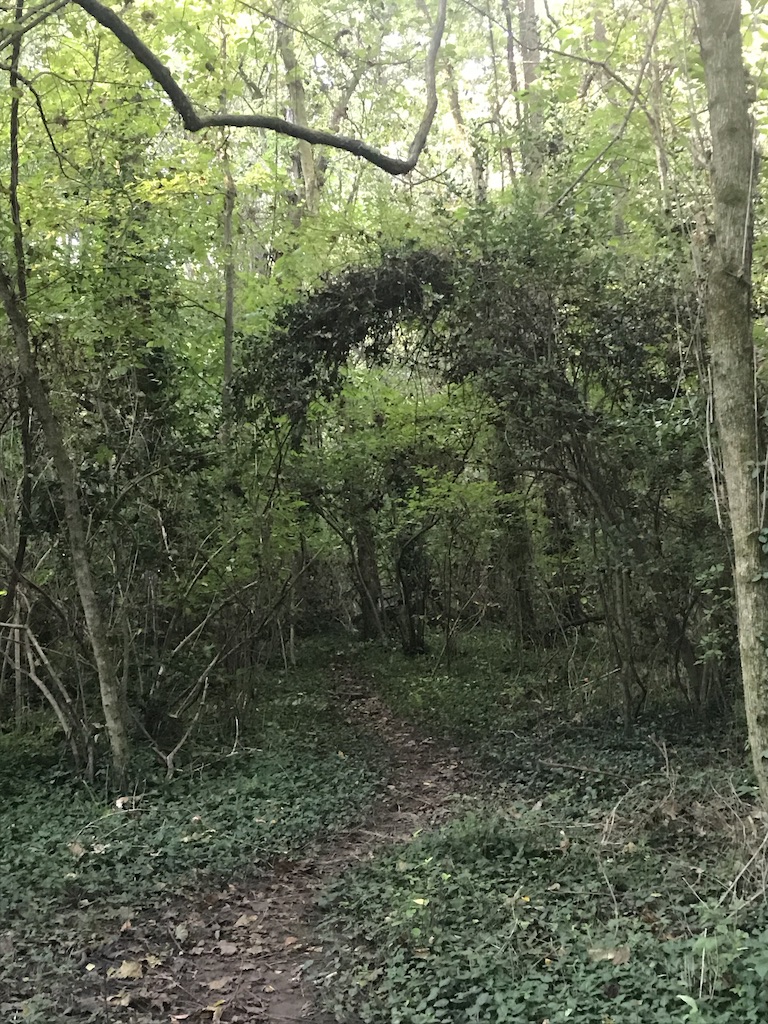
I come across the fairy bower accidentally, as most do. I was on the main path, bag slung over my shoulder with its pens and pencils quietly clacking together with my steps. I glanced down the side paths that wandered off the main, quick jaunts down to the riverbank. One to the left caught my attention, calling me back from my automatic forward motion. I looked down the path with its slight winding, a grapevine twisted in an arch overhead, tall enough for most men to pass through without stooping. English ivy thickly banked both sides and climbed to intertwine with the wild grape. The boughs didn’t quite reach down to the other side, leaving the arch just incomplete. Beyond it a new tree, verdant in its youth and against the ivy, stood like the centerpiece to this wild garden. The tricks of the fey, was the first thought that came to mind, and didn’t for a second believe that because I was within the city limits they would not also be here among the old growth forest. I found I had taken a few steps down the path and turned back to the main road. I nearly bumped into someone who clearly did not understand the need for distancing. 

He stood casually, leaning against an old hickory. His boots were clean and his clothes crisp; add a to-go cup of coffee or a slim briefcase, and he could be any local businessman just stepping out of the office for a bit. He carried nothing, wore no watch, no rings. If you didn’t know, you wouldn’t notice that he didn’t belong there. 

“Beautiful day,” he said, the barest hint of a smile playing around his lips.

“It is,” I replied. With a slight nod, I shifted my weight to continue forward. He came out of his lean to stand fully in the way between me and the main path. 

“This is a gorgeous time of year to visit. You have made it just in time for the leaves to turn and fall.”

If there had been any doubt in my mind, his lyrical small talk would have put that to rest. I smiled but did not answer. 

“What’s your name?” the fairy asked. 

I nearly replied. I felt the warmth of the day as a gentle breeze stirred the leaves beside us. 

“Not a lot of people out this morning, hm?” he mused, watching me. I had been hoping for some jogger or intrepid dog walker to interrupt with their passing. I realized that he had blocked the fairy path from sight. There would be no accidental intercession. 

“Your name,” he said, voice a little stronger and with a slight ring of authority. The fey command respect, even with their antics.

“Hawthorne,” I replied. Knots inside me that I hadn’t been aware of loosened, and my body relaxed.

He looked surprised. “Hawthorne. That’s not a common name. Your given?”

“Chosen,” I said simply. He nodded, satisfied.

“A strong choice. A name like that carries magic in it. The owning of it, the speaking of it.”

“Yes,” I said, smiling. “I know.”

A companionable silence fell between us as a flock of swallows took to the clear morning sky above, trilling, their song falling through the canopy like a gentle summer rain. 

“Have you no interest in continuing down this path for your travels?” he questioned me. 

“No, but thank you,” I said, firmly, but with respect. He looked me up and down, and his eyes searched mine. I maintained my polite smile; as his gaze lengthened, I raised my eyebrow a fraction.

“Very well,” he said, letting go of the search. “May the rest of your day be as lovely.” He stepped back cordially to allow me to pass.

“Yours as well,” I replied, walking back towards the gravel of the main path. I didn’t dare look back until I made the turn; as I suspected, there was no trace of the man. The bower stood silent down its crooked path, still ensconced in shadow. The light beyond was dappled and no longer highlighted the young tree; in fact, it had become indistinguishable from those that surrounded it. 

I left the woods feeling lighter. I had come here to heal. I needed to get out of where I was for my heart to stop seeing them at every turn. Here there was no history, no memories to dim new ones made. I need that space right now, in the immediate hereafter. We were never in this place together. And so I had come, seeking peace, and leaving with far more than I imagined.

I lied to the fairy I met, but with mischief and no malice. Giving the fey Hawthorne’s name lets me let go of a little bit of them; I can’t carry all of them, my heart is already so heavy. I know they wouldn’t mind; they had so many more (mis)adventures left. I can’t think of a better way to let them live them out than with those are not quite of this world, but not quite out of it either. 

Posted in Uncategorized

A Blaze of Glory and an Untold Song

On September 19th 2020 Hawthorne (Emily) Barber-Dubois joined their son Oscar in the stars. The fare for this unplanned voyage weighs heavy on the rest of us here on earth. They are survived by their brother, a man of considerable volume and clear blue eyes; their sister-in-law, a woman who has far less fear than she realizes; their niece, who never fails to lift the spirits of anyone around her; their mother, a woman who is generous to a fault and makes a hell of a casserole. They leave their daughter, the brightest light in this universe; cousins, aunts, uncles, chosen family and forever friends, and me. 

Hawthorne was born in the summertime of ’83, burning out at the rubber tree, a long-awaited first child to hard-working parents outside of Buffalo, NY. Intelligent and quick from the start, when their brother arrived three years later, they asked when he would be sent back for crying so much. Pictures of that time are scarce; the few that exist are tucked into a cardboard keepsake box adorned with sea life. They grew up creative and brilliant, only to be checked by poorly controlled asthma and the regimented nature of school and church. The markers for advancement weren’t their grade level, but the guitars they played and practiced on until their fingers bled. 

They left high school early and without graduating rather than fail another math class that didn’t make sense to them. High school had not been a place of youthful adventures and education as much as it had been the backdrop to bullying from peers and professionals alike. One teacher and her laminated promise to keeping kids like Hawthorne safe kept them coming back as long as they did. 

They traveled to Chicago and found themselves in a cult now made famous by Netflix. In six short months they experienced some of the highest and lowest moments of their queer life. They fell in love with a beautiful woman who touched their heart, holding hands in secret and away from the searching eyes of elders. They endured isolation and shunning for letting that love shine.

Hawthorne left Chicago, arriving back in Buffalo the morning the towers fell in New York City; they were one of the last trains to arrive anywhere that day. Conversations about America’s due for meddling in foreign affairs only hours before in the dining car rang true as their father picked them up at the station. They returned home to watch the first tower fall, Spot coffee and cigarettes in hand. 

They dated a boy they promised to marry, still believing their eventual destiny to be a pastor’s wife, still dedicated to being straight. It may shock some to know that this relationship did not work out. When they finally embraced their love of the feminine and the female, the scorned former fiancé moved out, and Hawthorne opened the Heartbreak Hotel with one of their closest friends. The pair charmed the pants off women, drank cheap whiskey on the roof, and sometimes cleaned on Sundays. Those golden days shined in memory over fifteen years later. 

Hawthorne went on to meet people and fall in and out of love, as your twenties are for. They formed a bicycle gang with their friends; the Spreadeagle Feminists made sure that George W. had as little chance as they could. They smoked, drank, wrote songs, and played every chance they had. They worked in group homes and coffeehouses; the jobs changed but the friendships developed within them blossomed. They settled down once or twice, ended up with a redhead in the banking world, and joined the Rural Metro EMT Academy and become certified in having a pulse and performing CPR, the two most skills the company demanded for the job.

It was unexpected when their love appeared on the scene.  Ella was a scraggly creature, more a blur of black and teeth than a dog when they first met at the SPCA. A one-year-old stray, wire-haired and just wired, the staff asked if Hawthorne was sure they wanted that one. Two days later after her spay surgery, Ella the Fitzgerald terrier took a nap on Hawthorne’s chest, and the two were bonded. If you asked Hawthorne what they wanted for a tattoo, it looked like this.

I had been lucky enough to meet Hawthorne in 2008 at work one night. They stood to the door of the trailer, smoking a cigarette as I stomped past, pissed and swearing about my partner on the ambulance. Hawthorne was coming off shift and I was coming on. I had noticed the hot butch in uniform but didn’t register more than that until the morning when I arrived for shift change to find them sitting on the donated couch with their feet propped up on a flimsy coffee table, reading the paper. They said good morning without moving, and watched me step over their extended legs to punch out. Their mischievous grin told me everything I needed to know. 

I can’t say a romance was born that morning, but I definitely had my eye on them. I was married but it was a rather open arrangement; Hawthorne was in a committed relationship. It would be years before the interest sparked again. Trying on pants in the women’s room, I complimented them the best way I knew how in that setting: a firm slap on the ass as I walked by, saucy smile tossed back over my shoulder. They were speechless – a rare occurrence. 

It was at least another year before they charmed me off my feet after driving me batty. Christmas 2010 they were partnered up with me, and like a little boy mistakenly pulling pigtails on the playground, unplugged the unreliable Toughbook computer I needed for my paperwork repeatedly. We ate chocolates their girlfriend had made and tried not to think about the other. We became lovers in a dangerous time; they helped me leave an abusive situation, and their own relationship ended with its fair share of drama. They left the ambulance company and started their college career intending to earn enough credits to apply to the police academy. The first day of orientation, they came home and asked me, “do you know what I can DO with a criminal justice degree?!” With their sights set on law school, they poured themselves into their studies. After one year they changed their major to sociology and pretty writing; they met some of their best friends and most influential people in their life. 

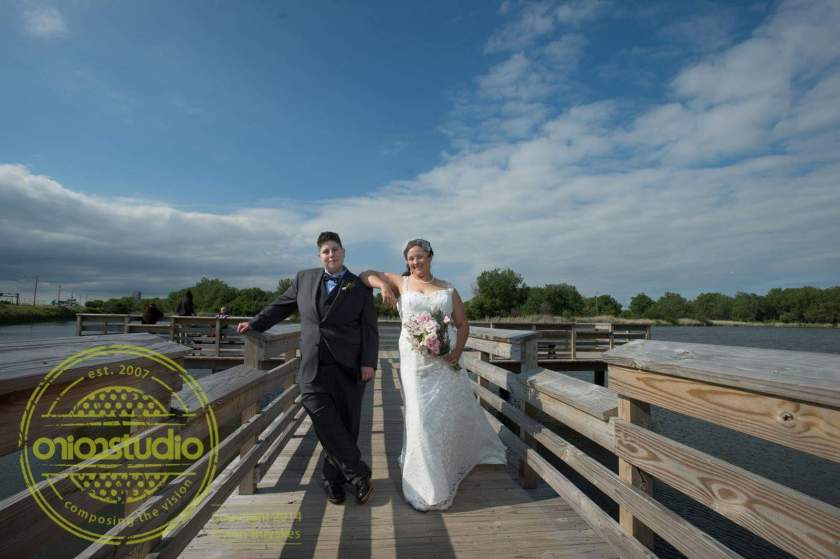
Hawthorne learned to hold a baby when their niece was born, a bright little girl with piercing blue eyes. The love emanated from them as they gingerly cradled her and the wonder filled their own ocean eyes. Two days later, with the sand on their knee to prove it, they proposed to me in the woods of Thoreau. We were married in June of 2014, on a beautiful summer day during the Allentown Art Festival. Their gray tux hangs in the closet next to my wedding dress and still carries the scent of whiskey. The honeymoon in the backwoods gave them a taste for country life that drove the city mouse to consider law schools in northern New England. 

They graduated cum laude in 2015 and earned the Conrad Vogler Promising Sociologist award. They were so proud to have been one of the small percentage of those who leave high school and go on to collegiate degrees. Within a few weeks, with no backup plan, no jobs, and no contacts, we packed up and moved to rural Vermont. Their dream of living in the middle of nowhere was realized, and they fulfilled a promise to Ella of having a yard big enough to run around in. They met the neighbor and discovered the local law school had a rugby team that was open to community members. Without hesitation and with zero experience on Hawthorne’s part, we signed up. Besides the whole fitness and running aspect, they had an absolute blast steering the scrum and chasing down the backs.  

That summer was spent in the river with a beer in hand by day and job hunting by night, with the daylight being much more successful. When they received the call back from Dartmouth-Hitchcock Medical Center for a job, they were talking about selling platelets to make some meager income because I refused to consider them selling a guitar. There was no end to their generosity and devotion to care for their family. Thankfully they were hired into their addiction research department, and the qualitative sociologist began handling more quantitative data than they had ever hoped to see.

On December first, Hawthorne fell down a full flight of stairs. It would be four months before their pain was taken seriously enough to get an MRI, and an additional two months for surgery. To literally add insult, they were laid off just days after their surgery as their department was merged with Geisel School of Medicine at Dartmouth. They then took a job at the local designated health agency as an emergency case manager, a job that recalled their time on the ambulance.  It was there that they met their adventure buddy, a friend who later helped give them a space to better define their gender fuckery. 

After that job was unable to work with them to aid their recovery after a second back injury and surgery, they worked at the local hardware store for the summer – another dream realized – and then at the local coffeeshop. Their barista skills from early-2000’s Starbucks served them well, and the tips were often returned to the same store for more books to line our shelves. 

In July of 2018, their wife gave birth to Oscar Prince, a beautiful boy who was stillborn. They held tight to the earthside body of their starside baby, knowing that this world was too fucked up for any firstborn son. They chose his only outfit, and drove him around the mountains when his ashes were released by the funeral home. They never forgot him, and never stopped loving him. 

Hawthorne returned to work just after what was supposed to be Oscar’s due date, and left the coffeeshop for a local residential crisis respite house. There they provided peer support to other Vermonters who were dealing with their shit, and found a beautiful community of folks that they connected with. They began playing guitar again, and in a few months Washboard Honey was born. 

In the summer of 2019, they came out as genderqueer and transmasculine; finally they were able to define themselves with words that rang true. They embraced their chosen name of Hawthorne, and began using they/them pronouns, since they often didn’t catch the message they were supposed to receive when referred to as “she.” They had top surgery at the end of the summer, or as they said, they Marie Kondo’d their breasts because they brought no joy. After that they pretty much refused to wear a shirt. They were finally starting to feel at home in their body; until then, they had thought of their body as a shell of pain that carried them around and didn’t match up with who they were. 

Their littlest love came into the world six weeks early, making them worry from the moment her mama started having preeclampsia. They wore their tweed coat and flat cap for three days, wanting to make a good first impression, and ended up having their fancy duds covered with an operating gown. They followed her to the NICU and held her first, keeping her skin-to-skin on their proud chest. In the pictures, Lucy Danger is already looking up at her papa with such wonder. They loved her fiercely, and it was returned the same. 

With the advent of 2020 also came a new wave of discovery and personal development. They began taking testosterone; nearly immediately their voice began to drop. Their soft alto voice deepened and richened into a smooth baritone; they picked up new harmonies and new skills to adjust for the transition. Their mustache and beard began to come in, their arms and legs became more muscular. Their thrill was a daily celebration. 

Hawthorne was injured at work just two months after Lucy was born. The medical system plodded along, finally recommending surgery in March, just as the novel coronavirus made landfall in New England. Ambulatory surgeries were cancelled, and Hawthorne waited, not patiently, for a date. It wouldn’t come until more than 5 months after the original injury. Unfortunately after that long wait, the “Hail Mary” surgery did not bring relief. 

Car rides were a particular hell for Hawthorne, but we travelled out to western New York for a cousin’s wedding over Labor Day weekend. We met up with close friends and danced at the wedding until we lost our breath. We met friends’ babies for the first time, and Hawthorne took Lucy down her first slides and on her first swings. They sang with their brother and their cousin, and smiled for dozens of pictures. 

In the dark hours of the morning of Saturday, September 19th, they woke up sick. After steadying out with an early morning bath, they took a nap. They fell asleep with their head on my chest, cuddled under their favorite blanket in our bed with Ella curled up behind their knees. Our son’s ashes sat under his golden crown across the room, guarded by his teddy bear as they always were. The sun poured through the windows in the early fall morning, throwing rainbows from a crystal prism on the windowsill. The frost melted to dew on the grass, and Hawthorne slept on. They never woke up.  

Hawthorne leaves behind a family devastated, a daughter too young to understand, and me. They leave a legacy of laughter and music. They leave a body filled with pain and burning, with lungs that didn’t like to work and a mind that outpaced us all. They leave a woodstove for me to curse over, a pandemic that continues to rage, and a political climate that is wrenching apart our democracy. They leave their dilapidated fishing hat and about a thousand flannel shirts. 

But the Universe must have balance; where there is leaving, there must also be joining. Hawthorne is reunited with their family who has gone before; their father and grandparents. They have finally met their father-in-law, and probably are avoiding my mother. They are able to take their son’s hand and hold him as close as they once held their daughter. The captain of misadventures is no longer held back by pain and trauma. 

They also leave us gifts – not just the crow presents of railroad spikes and shiny rocks, not just the memories. They leave us with their music, their words and harmonies. They leave us with the connections they made with us, between us. They have touched literally hundreds of lives. And they leave us with a reminder to live – to carpe the fuck out of that diem.

So when you are out in the world, finding your way from place to place, and you find a pen someone has dropped, or someone’s wallet in a snowbank, or an inhaler tucked into the crook of a resting tree, you will know that Hawthorne has stopped off for a little visit. When you hear someone say, “well I didn’t think that would happen!,” know that they just wanted to have a little fun. When you hear quiet music, play it loud; and when you see injustice, stand up and speak out. Everyone who knew them knows that Hawthorne was not a quiet soul; I don’t see any reason that should end. 

Posted in Uncategorized

Time Crawls On While You’re Waiting for the Song to Start

Forgive me, reader, for I have slipped, it has been nearly two months since my last blog post. I find myself staring out the window, waiting for the darkness to fade rather than looking at my screen. I want to write; I love my Saturday mornings. I made my coffee hot in deference to the 47 degree morning. Sitting on my couch, I watch the thin line of the cursor blink on a blank page, waiting for my fingers to move. Inspiration did not strike, so I pulled up another screen and started to let my thoughts flow. My brain moves quicker when I journal; reading back, it sounds as if it is spoken, packed with silence-fillers like “so,” and “ugh.” I typed away until I felt like I could write, brain pan emptied of the mundane and clutter. I pulled up the blank screen. The cursor pulsed, a patient heartbeat, keeping time. I feel like there is so much I have thought to be writing about that I just cannot access right now. We recently went back to Buffalo; an 8 hour drive with the baby, dog, and avoidance of public rest stops. I had wished more than once on those drives for a device that would simply pull the “written” thoughts from my head and record them without me having to do anything. My mind wanders to the days of tape recorders and a montage from Twin Peaks of the agent recording notes to Diane before I snap back. The cursor blinks back at me.

2020 has been a year of upheaval for me, someone who thrives on structure and consistency. That is not to say I’m not agile or able to adapt; I worked in EMS for 10 years. You never knew what you could be faced with next. Now that I work in an office setting where I am not holding anyone’s life in my hands, I have not kept up that level of high alert, but I am still able to adapt to changing situations and environments. Outside of work is a different story. I don’t live on the balls of my feet anymore; I did that for years, living in dynamic and sometimes volatile situations. That state is far too exhausting and stressful for me to be comfortable now, especially with a baby who stills smells new sometimes. I am not a spontaneous person, a fact that drives Hawthorne’s free spirit up the wall. I have recognized and accepted this about myself for a long time.

When things are good, I can keep a lot of plates spinning. I have the balance; I can keep an eye on them, making small adjustments, knowing when the next plate needs a touch to keep on course. I can handle things; just let me be, don’t approach too quickly, and refill my coffee often. When emergencies arise, I can focus on the immediate needs: pack the hospital bag, make childcare arrangements, respond quickly and calmly. You only need to worry if I’m worried, do I look worried to you? No ma’am. 

But when the bottom drops out and my whole world tilts, the plates begin to crash. I crash as I desperately try to not only catch them, but keep them spinning. I grasp wildly for those threads of control as they tangle and escape, slipping from clenched fists and burning on the way out. I stand shattered in the wreckage, not knowing where to begin. 

There are few acts that show off such vulnerability more clearly than writing. By the time of Oscar’s brief life, I hadn’t written seriously in years. A few poems here and there when I fell in love, a couple articles for work, papers for school. While pregnant with Oscar, I read Like A Mother by Angela Garbes. I sat in the river, my swollen belly keeping the book out of the water, his kicks and rolls adding turbulence as I devoured her words. The call in my head grew louder to write my own story as a queer woman navigating the overwhelmingly straight world of impending motherhood. I distracted the call with freeze pops and let my dream languish for Someday.

Then Oscar’s heart stopped beating beneath mine. The plates all fell as my world was irrevocably changed. I wandered the debris field for months, barely able to put the biggest pieces back together. I read a lot about kintsugi, the Japanese art of repairing broken pottery with gold. It was hard to focus on the striking beauty of reparative work when the hands piecing everything back together were also shattered. I spent a lot of time staring; looking, but not seeing. The blank space stretched on and on, the only thing left unbroken. 

My soul had been wrenched out of my body to lay prostrate, soft underbelly vulnerable to a sharp word. My body recovered slowly, and I became pregnant with Lucy. 

The first difference between pregnancies I noticed was the new and complete lack of serenity. Everything was jagged, the shards of our life Before now sharp with worry; panic pierced through worn skin and would be soothed temporarily by our team. I tried to keep healthy, but many times I wondered what the point was. I had done everything right with Oscar: kept the appointments, tried to lower my stress level. I did everything for him, and he was still gone. 

When I stumbled upon the Pregnancy After Loss Support group, I admit, part of me wanted to look away. Yes, I had been lamenting the lack of resources for queer families; but there is something about isolation that can be comforting. Grief is an insular world that muffles the noise and dampens the senses. I wanted resources to be available, but I also wanted to stay wrapped in my heartbreak. I was scared to open up to other people’s losses. I was afraid to take on their sorrow, as if it would enhance my own.

As the weather grew warmer and his first birthday approached, I could feel the call again, louder, more insistent, an unrelenting drumbeat. I emailed the PALS link and wrote about attending Pride with empty arms. Within two weeks, I became a weekly contributor. And just like that, I was writing again. 

It took some time after Lucy’s birth to be able to tell her story. My memory of the events is still hazy, and is not likely to ever become fully clear. Preeclampsia and the associated treatments will do that. I am content with the good things I do remember from that time, namely, hearing the first squeaks of my daughter in the operating room, and having her tiny burrito-wrapped body pressed to mine before she was whisked away to the NICU. 

It wasn’t long after publishing her last update to PALS that I knew I couldn’t stop writing again. I had done it to help others and to help my soul heal; waking up halfway to dawn every night made me realize that I still needed that. I had spent my pregnancies doing everything I could for the life inside me. I had given up my autonomy and put myself solidly lower on the priority list. As a mother to a living child and as a wife, I continue to put others needs before my own. It’s something I have done my whole life; I’m a pleaser, and the worst feeling for me is that I have disappointed someone. I am good at doing what needs to get done. It has taken 10 years of Hawthorne telling me to take care of myself, and a new life depending on me for survival, to make me realize that I while I have been getting things done, I have been disappointing myself.

Once I had that tiny little revelation, I decided to become my own coach. Listening to podcasts and starting a daily writing practice, I have found myself in a season of self-discovery and development. I have started a daily writing practice, and I am starting to fill in the self-care and self-building boxes I’ve been making for years in my bullet journal. I’m reading the NY Times daily newsletters, following blogs, and have finally embraced the wonder of podcasts; I need to shoutout my two favorites, which have been instrumental to me these last few months. The Art of Speaking Up gets me to work in a mindset ready to show up for my career and my dreams and makes me look at myself through a critical yet supportive lens; EmpowerHER challenges me to get off my ass and own my shit. I’ve managed to read over 200 pages for pleasure (Stephen King’s The Shining – thank you, Hawthorne, for not making me read it in the winter) for the first time in years.

Oscar gave me another gift this year on his birthday. When I was driving and thinking about him, radio off for once, I had a future memory (I don’t like to call them visions). I watched as entered a small bedroom painted in a calm slate blue with a window facing the forest. Dark wooden furniture was brightened by large-leaf plants. I held my coffee, sat down at the desk in comfortable clean clothes with my hair pulled back, and I was at work. I was a writer.

That image has stuck with me, and I find myself returning to it. I don’t ever imagine myself giving up my day job; I love my work, its challenges and its impact. But why can’t I also write?

This blog has become extremely important to me, because writing has been a passion of mine since I was a child. I am extremely important to me. It’s taken me years, heartbreak, and immeasurable loss to get here. If I want to show up for my family – for my huswife, for my daughter, and for my starside son, I need to keep showing up for me. 

I can’t say I’ll never falter, but I can promise I will continue to get up. I am no longer waiting for the right time, I’m not waiting until I’m ready. This is the time for messy action. 

So I’m putting it out there, reader, universe, whoever is reading. Writing is important to me, because I am important to me. And I’m going to honor that. 

Going forward, blog posts will be posted every other Saturday. They will cover a variety of topics, which will be categorized. Maybe I can even figure out how to color code them in WordPress. I will be migrating my PALS works here soon. 

I am a writer, and I will be on the New York Times bestseller list. You read it here first, folks. Watch this space.

Posted in Uncategorized

I Miss the Weight of You

Monday, 13 July

I can feel the distance growing. The saturated colors of July dim to deep shadows as the days pass. My arms and legs twitch, muscles hoarding both energy and emotion; motivation becomes a memory. The state and country continue to open in a so-called “post-Covid” world, but the burning in my chest to scream that there is no such thing has faded. As Closed signs are flipped over and people take their seats six feet from others dining at outdoor tables, I am pulling on the shutters and setting the hook to keep them shut. Oscar’s birthday is approaching, tumbling closer quickly now that Hawthorne’s has come to pass. I turn inward, closing off my body, mind, and heart, even my energy. It’s hard to recognize myself in these days.

My period has returned, with gusto. My body reminds me of the emptiness, an ache that my womb has no one to hold right now. The cramps sweep over me, more painful than I ever remember them, each one a clenching reminder that she stretched and grew and pushed, and gave our son a birth attended by empowerment and heartbreaking in its finality. Every crescendo echoes the contractions that brought Oscar into the world on that clear-blue day. 

My tolerance for noise and motion has changed drastically in the silence that followed. I used to be able to at least try to harness whatever chaos surrounded me. Now the sheer amount of sensory input I am faced with is a bolt up my neck, paralyzing my hands and feet from moving and sharpening my tongue. I can’t think of what to do; I grab onto minutes of focus before my attention flits away or my eyes close again. I am tired constantly, regardless of sleep, but I have trouble finding any rest. The anger is back, jaws snapping and shredding my patience, and the words “I’m sorry,” take up residence behind my sarcasm. Hawthorne bears the brunt of it, both of us knowing they neither cause nor deserve it. 

My grief for my dead child lives. I don’t want to talk to anyone else. I keep to myself at work; I let texts from friends go unanswered. Last year, on his first birthday, I had a breakdown – I was flailing, and I needed help with the rage, the intrusive thoughts, the devastating ownership of my failure to keep Oscar alive, even as I carried Lucy through her eighteenth week. I went to a healing place and found people who made space for me and my grief and surrounded me with compassion. It was that week we found out that the sex of the baby I carried was female. It helped to know that; it was an additional weight to the side of the scale that said no, this pregnancy was not to be a repeat of last time. The knowledge added evidence I needed so desperately to hold on to. Losing Oscar did not mean I would lose this baby. My guilt was a liar, and fear my constant companion.

The day Oscar was born was beautiful. A Japanese maple stood sentry in the courtyard outside my window at the birthing center. It became a focal point for my entire stay. On our way home a couple of days later, we picked a few of the merlot leaves. They wait on the bottom shelf of a dark bookcase my grandfather built nearly forty years ago, pressed in a book likely a decade older that we rescued from the pick-and-poke. Like our houseplants, most of our books are rescues, snatched back from the metal jaws of the incinerator. There is so much that is tossed away seemingly without thought – books and faux crystal candy dishes, dingy plastic children’s toys and threadbare table runners, dusty photo albums with a couple faded memories still tucked inside. They all meant something to someone once; maybe it was forgotten, or finally let go, or simply left behind. I think of the blue velvet box where my son’s ashes lay in a marble urn that nestles snugly into the palm of my hand. I hope that after I’m unable to take care of it, no one forgets the fierceness of the love inside. May that it never end up on a table at the tri-town dump, velvet worn away from corners and the clasp dangling from one tiny screw.

Friday, July 17

I don’t know how to do this. Last year I was consumed by my grief, unable to hold space for even Hawthorne. I keep hearing it gets better with time. I’m still waiting.

Last night I dreamed that I was burning in a hell I don’t believe in. My skin turned black with ash, shifting rivers of fire crackling underneath as if I were bathing in lava. A keening sound poured out as I writhed, a wail drawn up from deep, deep below, deeper than any human can hear. The pain was inescapable, every muscle and sinew and pore weeping. Every ounce of my heartbreak was on full display, weighing me down like so many chains. Here was the pain I had earned for not keeping Oscar alive; here was my due.

The ferryman met my gaze and snapped his bony fingers. I found myself immediately removed from the fires and surrounded by emptiness. The burning was gone; the pain was gone. In fact, all feeling was gone, purged. I can’t even say what position my body was in, or if I even had one – there was nothing. It felt like absolution after the flames. I stepped between those two worlds at the mercy of the ferryman until I woke to clear blue skies and birdsong, jarring me back into this pastoral landscape.

I remember waking that Tuesday morning, thinking that the date sounded important; I told myself to remember it. Maybe it was the day I’d go into labor. After all, I was massive, the baby had been tracking far ahead on all the growth scans. It would be several hours before I knew that it was over.

Sunday, July 19

Lucy whined me awake minutes before my alarm. I snuggle her close, breathing her in to reassure myself of her presence. The night of my dream we had caught Lucy sitting upright in her bassinet. Rather than give her a chance to figure out how to climb out, I had dragged in the pack-and-play, too terrified to let her be more than a foot away from me. I slept with my head at the foot of the bed, all the better to hear her with. We need to put her in the crib next week. We need to finish building the crib next week. We need to finish the decorations, the curtains, and a million other things. But first, we need to get through today. 

There is nowhere to visit a stone, no name carved to trace. Wildflowers bend in the wind, summer’s bouquet for all occasions. The stream babbles on over stones slicked with green and brown algae. We have no cake, no celebratory plans. We have broken hearts that we try to keep from piercing Lucy in our sorrow. She is our bright and shining light, and I never want to see it dimmed by our grief. 

It’s hard to reconcile the brightness of our living daughter with the idea that if we had not lost Oscar, we would not have her. I could never wish her away; her laugh and her little words keep the lamp lit when my ears roar with the silence that followed Oscar’s birth. The grip of her fingers as she pulls my hand to her mouth ease the memory of his tiny, still body as my heart beat around his. The breaths she takes move the air that he never got to.I don’t know where I would be today without her, without Hawthorne. I don’t know how to be without Oscar, still. I don’t know how to celebrate and mourn him while raising her. I don’t know how to keep stepping between these worlds of pain and joy. I only know the road I’ve been given will forever be guided by the love embodied in my starside child.

Posted in Uncategorized

I Haven’t Seen My Father in Some Time

It is Saturday morning. I have given myself a treat, setting my alarm to sleep until the clock hands stand straight; this is sleeping in. I awake mid-symphony, birdsong ringing out. I had fallen back asleep to the opening notes, having cuddled the baby back to sleep after her bottle. She lays in her bassinet, one of her last sleeps by the edge of my bed. She has outgrown it; if I keep procrastinating on adding the last three screws to her crib, by next week she won’t be able to stretch out. She sleeps with her arms folded behind her head and legs out straight, the picture of relaxation. I lay my hand over her hummingbird heart for a moment before stretching myself beneath the blankets, sheets cool where my legs hadn’t lain.

Footsteps echo distinctly, coming from downstairs where the floors don’t creak so much. I pause a moment, hearing Hawthorne’s soft snoring, and the dog’s much louder. The footsteps stop as abruptly as they started, no fade out, no door opening or closing. I relax my shoulders, remembering our ceiling fans have been running for days, and the “footsteps” are the occasional off-balance whirr of the blades. But I don’t discount a visit from the other side as the solstice approaches. 

Midsummer is a time that carries weight. Her own footsteps are heavy with grief and stalwart with tradition. The days in this most spiritual of times tick by, laden with memories and marked by anniversaries. The sunlight off the vibrant new leaves belies my heart’s gray disposition, the bright colors across gardens and lawns a painted masquerade to celebrate the longest days of the year. Such juxtaposition seems fitting; after all, people send flowers for sympathy, and June is the showstopping season of blooms. 

My father-out-law’s birthday was June 9th, my father’s June 19th; Father’s Day falls on the 21st. This stretch of time, we fish for our fathers, spinners and spoons pulled by a seemingly invisible force through the clear water, hoping to catch the eye of a bounty of trout. Some years, it’s the first time we catch a fish. It was during this confluence of celebrations that I caught a near state-record walleye out of the Niagara River six years back. We always practiced catch and release – men aged 18-64 were supposed to consume no more than one fish per year out of these waters, and women, never, due to the mercury and other pollutants. This time, however, the roughly 13-pound fish went to a local family after they expressed their horror at our plan of letting it go. I think of that moment often, and how humbling it was, having my privilege pointed out with such genuine shock and lack of intention. Clark was still alive, and thrilled with our story. 

Hawthorne and I married in the space between their birthdays, on the 14th. Our wedding was perfectly tailored for us; classy (not that we are, really, but for our biggest party, absolutely!) with plenty of whimsy, and even more food and drink. Clark and Hawthorne entered together and walked down the aisle; my cousin gave me away. There was no father-daughter dance, but the DJ played Prince and we danced all night long. The one cloud on the day was Clark’s seizure; he had multiple strokes before I met him, and occasionally would experience seizures as a result. He was well-cared for though, and considering the crowd, it was calm as far as scene go. More than half the guests hailed from emergency medical services and other professions in the medical field, so when the ambulance came and picked him up, the responding crews had to field reports from half a dozen medics in various states of inebriation. He stayed overnight in the hospital and, all things considered, was no worse for wear when he returned home the next day. 

As they grow up, people learn that their parents were not perfect; it’s a harsh realization to come to about someone. You learn their fallibility, their faults and failures. When they die, however, it can be easy for some to gloss over their less-than-perfect traits and actions. We have been so conditioned to not speak ill of the dead that a sheen of sainthood often shrouds the mistakes they made, or excuses them as a product of their time. It takes work to see them as whole, flawed people, but it’s important to do so. Relationships are complex, and those between father and child no less so for its focus on creating and raising a life. 

Father’s Day added new knots to this tangle of emotions the past couple years. Hawthorne had not grown up with the same bone-deep knowledge of one-day parenthood that I had, and was so excited to talk to my belly and make plans for us all to go fishing to celebrate. Of course, it did not turn out that way, and our little boy left us to grow up starside, holding the hands of our fathers instead of ours. I cannot say what last year was like; with Oscar gone and Lucy waiting in promise, I was so enveloped by my sorrow and rage that I do not remember what we did. The reminders are out there when I’m ready, but looking backwards is not something I do lightly, so those memories will wait. 

This year, we navigate the grief we carry of our own fathers along with the loss of our son and the joy of our daughter, all against a backdrop of transition and testosterone, and the sudden theft of hope for Hawthorne’s long-awaited surgery. Zoom out further and the volatile terrain snaps into focus: the assault on black bodies by those who are sworn to protect and serve, the disregard for scientific process and recommendations in an ongoing pandemic, and an administration that is intent on keeping queer folk (among others) second-class citizens. There are moments when I feel as if we are stuck inside a thunderstorm inside a hurricane and oh yeah, the planet is warming and the oceans are rising. The way forward is bleak and dark. 

And then, as the world feels like it is on fire and all I can see and breathe is the smoke, the beacon of hope that is Midsummer shines through. The universe holds us with gentle constancy and faces us toward the wonder of the sun for as long as she can. I am still a baby witch but I feel a deep connection to the solstice and the turning of the seasons. The veil thins and allows me to feel the push from the other side, a flow of strength and hope and tenacity from my ancestors, including my father. He would want me to be more physically active, eat better, drink less coffee. But he would also want me to fight on through the dark days and raise my little girl to be a fighter, too. 

I know our fathers would be so in love with their granddaughter Lucy Danger, our brightest light. I look out at the sunshine and the Oscar blue sky, and know they grieved for us even as they accepted Oscar from the stars. I see Hawthorne holding Lucy, and know she is so lucky to have a papa who is not like other dads, but is strong and will teach her to be utter authentic in herself. 

The day is long enough that there is space for grief in this sacred time, for missing those who are gone; especially as their birthdays come all stacked together. But there is also space for joy, as we share memories and tell each other stories of our fathers. There is light to play by, to learn by, to grow by. And even as the days grow shorter, we will remember the men who became our fathers, who taught us to fish and play guitar, the value of a strongly-worded letter or a well-placed phone call. We will remember their faults and their triumphs, what kind of parents they taught us to be, and not to be. I’m learning now that parenting is not just a lifelong journey on the part of the parent; the learning goes on long after they’re gone. 

This one is for my father Paul, for Hawthorne’s father Clark, and for Oscar, who first made Hawthorne a papa. We miss you all. Stay wild out there. 

Posted in Uncategorized

I’m Drawn to the Ones That Ain’t Afraid

This is the first time I have sat down to write in a while. These June days are long and tumultuous; the nights are broken into chapters of sleep, interrupted by pain. I have found myself startled awake by the cries of both my beloved and my baby only to find salt on my own cheeks. I look at this tiny, wondrous creature and despair at the world we have brought her into. I look at my beloved, with a strength and resilience I have yet to see matched, and my heart wrenches with silent sobs.

Today is our wedding anniversary. We married in Pride month, during an art festival under an administration elected on a platform of hope and change. We were married legally as two women, in a church, with 8 people fit into a limo, not a thought to sharing the close quarters with each other’s laughter and singing.

The then-and-now picture that emerges next to that happy day is in negative, a strip of film that had fluttered away when the photographs were last handled. The sun is shining still, but the golden light has never felt more temporary. June is still Pride month, and we are still married; but the rainbow that shone so brightly has wavered and dimmed. 

The art festival, shared limousines, and singing in enclosed spaces have all been paused by the coronavirus. Infections are rising as restrictions lift across the country. Pride month has given way, rightly, to gay wrath month. We hold our platform steady and try to use our voices to amplify those of the black community, who have been disproportionally killed by the police. We remember who stood for their rights in 1969 so that we may stand together today. We have lost a son, and felt his spirit when our daughter touched down earthside on Dia de los Angelitos. And my partner-in-crime, by beloved, is no longer a woman. 

Simone de Beauvoir said that “one is not born, but rather becomes, a woman.” To me it makes sense, then, that a woman can continue to become – even if it means that “woman” is not inclusive enough of a term, it can be a resting stop on a person’s journey of identity.    

Hawthorne is the not the first first name of my love. She/her pronouns do not encompass the wonder that is this person. The love of my life transcends the binary, genderqueer and proud. They have never been one for conformity, so why should their gender be any different? 

Two days ago, the Trump administration rolled back healthcare protections for trans* folks as defined by the Affordable Care Act. I was immediately incensed. It felt like a tipping point; I felt like the world was exploding around me as I stood, screaming, hands clamped over my ears so I could not hear the impacts of the shrapnel on the disenfranchised. How much more can I take, I wondered, rage pulsing through me. I can feel the echo of it in my blood still. 

We had fought so hard for marriage equality, which was passed and the most prominent house in the land was lit with rainbows. We were acknowledged, we were validated as a community. Congratulations, you are people too! Enjoy it while you can! is what the cake should have read. Hawthorne saw that then; I foolishly held more hope. 

Hawthorne is due to have surgery on their back in 9 days. This new injury occurred over 5 months ago; this is not their first tangle with the healthcare system, but it is the biggest one since they have advanced on their identity discovery journey. We live in a progressive state – at least one that is progressive in their practice, even if it takes some time for the laws to catch up. There seems to be an air of, “oh, we have to spell that out for people?” in our legislature. The majority of the time, it is an accepting place. And when it isn’t, people take action. I know that this move by the administration to redefine sex-based discrimination as based on biological sex (as well as decrease abortion access and decrease translation resources for non-English speakers) will not fly here, nor will it impact Hawthorne’s long and desperately-awaited surgery next week. But I worry. 

Covid-19 put off one particularly important thing. Hawthorne was in the process of changing their name before non-essential work stopped and travel was restricted in March. Here, it’s not a terribly hard process, but it does require certain government offices to be open. We are now looking at how to relaunch that process; it’s difficult for people who operate outside the gender binary to constantly hear their former name in the already fraught setting of healthcare. Electronic medical records are also notoriously slow to update with changes to the capture of demographic data. All this coalesces with the injury itself and the excruciating nerve pain to make every healthcare appointment a daunting endeavor. 

Right now, Hawthorne cannot carry our child easily or safely; walking is manageable, but stairs and sitting upright for any length of time is difficult. The nerve medication is a time-thief that steals the words and slows the speech of my favorite conversationalist. I miss seeing their ocean eyes unclouded by constant and debilitating pain. I wish I could alleviate that pain, even for a minute, and give them just a moment of sweet relief. I don’t know how they find the strength to carry it day after day. 

The amount of pain they have been left to languish in is inhumane. To add the constant need to correct their name as others speak it adds emotional overtime; then, for this embroiled country to put such hard-won progress in reverse and reclaim the ability to deny rights to trans* people removes even the vestige of respect. And still they rise: they make the calls and complete the paperwork and attend the appointments. The definition of insanity is not repeating the same action and expecting the result to change; that is tenacity, that is perseverance in the face of the storm. Hawthorne stands against the winds that buffet them with inadequate pain relief, with judgments about weight, mental health, and addiction thinly disguised as medical concern, and tangles of red tape. 

And here’s the kicker: they are afraid. Of the surgery, of the disregard for black and brown lives in this country, of the Republican National Convention now announcing their platform will still oppose marriage equality and support conversion therapy. They are afraid as I am, and that fear crowds out their anger while it elevates mine. But still, they stand and make their progress, inch by excruciating inch, intent on clawing back to their true self. They do it afraid. Their courage is nothing short of astounding.

They are my Pride. And whenever need be, I’ll be their Wrath. 

I thought I was going to write about anger today. Instead, the love came pouring out of me. If blog posts have dedications, then this one goes out to you, my love. I’ll be by your side through all that is to come, as I have all we have been through. You have stood by me, strong and indominatable, fluffy and dented, maybe bent but never broken. We have had ten years together, six married; two births, what feels like countless deaths; joy personified and vast rolling oceans of pain; a hundred storms, a thousand rains. Let’s get back to the garden, there are new greens to tend. Here’s to the next step in our forever. 

Posted in Uncategorized

Guest post from Hawthorne Barber-Dubois

Clark Franklyn Barber died his final death at 4pm September 20th, 2016. I saw his final death because he was a man who died 100 times. There wasn’t much for him to leave on the 20th. Gone are the blind eyes that saw only light and shadow. My father was an intensely private person, so much so that there are probably people in this room that never saw his eyes. I was surprised that Aunt Lynn and Mom were able to find this many pictures of him not wearing his sunglasses.

Gone are the atrophied muscles and arthritic knees, shoulders, hands, and wrists. His was a body well abused. His physical feats not sound legendary. He ran up Mount Marcy carrying a backpack loaded heavy with rocks, ascending and descending in the same day. He did a 40-mile day hike in Sweden and slept in the mossy turret of an abandoned castle. He won a fist fight against a group of Russian sailors who were displeased with his banjo rendition of Norwegian wood.

Gone are the hands that held our hands, held micrometers, held guitars, held banjos, held maps, held motorcycle handlebars. 

His broken back is gone.

A few months ago, Dad told me that the CIA attempted to recruit him out of high school. He spoke fluent German and they wanted him to infiltrate Baader-Meinhoff in East Germany. My dad refused. I asked him why and he said it was because he didn’t want to serve his country. He lost too many friends and classmates to Vietnam. He told me once that Grandpa was the last hero in this family, but I disagree. He waged a different war. One fought in factories, standing over machinery and enduring the physical demand and the mental tediousness that the work required. I remember waking up one morning after his first stroke to the sound of him crying. He was sitting in the living room struggling to lace his boot, he had forgotten and then remembered that he no longer worked. 

He was freed from his shattered mind. Once exact, and sharp – his trade was so obscure that we all had to Google how to spell it for the obituary. After putting in over 20 years at Cutter he was laid off. Unable to find trainings for other work, he taught himself physics using college textbooks that he bought at yard sales. He measured his world with micrometers, he underlined books with rulers. He raised us to look at the world with wonder and curiosity. We listened to far-away lands on the shortwave radio, peered out at the night sky through telescopes, and hiked through the forest preservation looking for fossils.

Gone is his beat-skipping heart, the heart that loved us. I was able to go back home for several days last month and we were able to spend some time alone together. He was still lucid. We talked about music, and movies and shared memories but mostly he talked about his love for us. He showed his love in the same way that his mother did, by asking us, telling us, and reminding us at every conversation to be safe, be careful, drive carefully. He told MJ to remind me to wear my seatbelt in the car. He also showed his love by making sure we had enough to eat. When we would go out as a family, he would often order nothing so that we could get shrimp dinners and beef hash. He would eat the shrimp tails, we would re-enact the scene from The Blues Brothers, “How much for your women, how much for the little girl.” He would eat the solitary leftover egg and then go home and make himself a bean sandwich for dinner.

He was thoughtful. When Mom and him met it was love at first sight. Mom saw him across the dining room at Potsdam and turned to her roommate and told her, “that’s the man I am going to marry.” Later they would go sledding, Mom took a bad spill down an icy hill and got pretty banged up. Mom went home to get cleaned up and thought to herself that if really is the one, he will show up with hot chocolate – and Dad did.

Dad’s thoughtfulness took many forms. He used to proudly tell anyone that would listen that he was an ex-Baptist deacon with a lesbian daughter. He went to Pride every year he was able, and he would stand outside of Spot Coffee during the Dyke March and wave to us. One rainy year he showed up to give me his umbrella and to give me a hug.

Even in his last moments his love for us was apparent. He wanted me to tell Mom that he knew it was a hard 9 years for her and that he wanted her to go out and have fun. To find a social group, to go to church, but most importantly have some fun.

He wanted Matt to know how proud of him he was and proud he was the kind of man that Matt is, that he has a good reputation and that people respect him. That he is a good father to Geneva and that he is a big guy but doesn’t use that to intimidate anyone.

I asked him what he was going to do when he got to Heaven. He didn’t think about his response very long. He was that he was going to meet the Lord and get a bike. He wasn’t much of a church-going man but he told us that riding his motorcycle was like being in church. That sometimes he would ride down country roads and that the trees towering overhead reminded him of being in a cathedral. 

He looked forward to being reunited with his Mom and Dad, with Buster and Quigley. 

He looked forward to not being confined to his well-abused body, the broken back and shattered mind. 

He wanted everyone to know that someday we would all be reunited.

His last days were ones where he was with Mom, at home, and in no pain. He had his music and all of our love.

To quote his favorite writer, Kurt Vonnegut.

Everything was beautiful and nothing hurt.

His ending was beautiful and nothing hurt.

Clark is in Heaven now, and everything is beautiful and nothing hurts. 

Posted in Uncategorized

Don’t Stop Thinking About Tomorrow

It’s the second week of April, and it has snowed nearly every day this week. The heavy, wet flakes cling together in the shadows, blanketing the barely-awake grass in patches so the snow looked crocheted. It will melt as the sun encroaches, seeping into the cold ground. The brook has finally receded back to its springtime levels after rising a few feet during a day of torrential downpour. By the time we walk in it, it will be impossible to tell which storm or melt moved new boulders into our path. 

The air is no clearer, there are no changes in the traffic on our road. Stay-at-home looks almost no different than when the world is bustling and busy. We still hear a plane maybe once a week; logging trucks still thunder by. 

Our governor declared that Vermont has passed the peak of coronavirus infection. Watching the first signs of a plateau in cases, I am almost ready to be maybe cautiously optimistic. To paraphrase the meme I’ve seen regarding the northern New England states, staying six feet apart seems awfully close. Vermonters have been pretty good about staying, in local terms, one cow apart

We have not seen the influx of illness and death that had been projected just 4 weeks ago. Social distancing, “stay home, stay safe” orders, and the Vermont attitudes toward independence and resilience are working to reduce and prevent transmission of Covid-19. 

Working for the hospital as a non-clinical member of the infection prevention team and scrolling through my echo chamber on Facebook have validated this first tingle of hope that we have avoided catastrophe. 

Of course, one only has to blink to see outside that bubble.

I have decided that arguing with men on the internet is a form of self-care I am indulging in during this pandemic. I have not been one to wade in to internet arguments much before; I don’t enjoy feeding trolls. When I did engage, it was not necessarily to argue (ha!) but to correct something blatantly false that wasn’t also a conspiracy theory – I have my limits. But right now, there is a deadly pandemic; a gorgon at the door, its hot breath blowing in from New York and Massachusetts. 

When I worked in EMS, we had to prepare for blizzards and hurricanes, and in 2014, for the possibility of Ebola finding its way to us. My counterparts made the necessary arrangements and backup plans but teased my high level of concern in both situations. I was a newer member of management, relatively young in the field, and one of extremely few women at the table; I was not as jaded when it came to preparing for disasters that never seemed to materialize. I was better at keeping quiet then, too. I did not fool around during PPE training, but I wasn’t as vocal as I am now. 

Seeing the carelessness with which some people are conducting themselves during this pandemic enrages me on every level – personally, professionally, and academically. The misplaced bravado, the utter disdain for guidelines, the willful ignorance of science pumps up my blood pressure. I feel it build like some sort of apocalyptic katamari in my chest, jagged and off-kilter, heating and churning to boiling point when I can’t stop reading for incredulity. I need to release the valve, blow off some of that steam; scalding men on the internet who call me a sheep has been a fun little release (I am specifying men here because when I argue with women, they don’t often respond; and when they do, it lacks the utter condescension and vitriol).

Why is this affecting me so? Why can’t I just scroll past? I don’t like how much time I spend on social media anyway, why can’t I just put my phone down? I have asked myself this several times lately, and the answer comes from my idol, Leslie Knope:

I care too much because I understand the stakes, and I have seen enough suffering.

I have seen the panic in the eyes of the vented patient when the perfectly spaced breaths aren’t enough, when the air sacs in the lungs fail to inflate. I have locked eyes and delivered breaths through long, drawn-out minutes of a power outage, waiting for a generator to click on, and a machine to take over the squeezing of my hands. I have seen the terrified disbelief in the eyes of someone drowning by inches in a dry bed.

I am no stranger to Death. I have seen her come for the unfamiliar and family alike. I have felt the brush of her hair as she has reached past me to spirit away the hand that I hold. I have ignored her gentle admonishment to stop when pushing, pushing, pushing on old and broken ribs. I have seen her leave the memories, a trail of blood-red rose petals to the afterworld; and I have seen her snatch away breath with greedy hands. I have seen her wait patiently for my father, and smooth my mother’s hair away from her soft face. I have seen her cradling my son, tears in her eyes, an unspoken promise to care for him. No, Death and I are not strangers. 

Death has already come for tens of thousands around the world, invited to this grim party by the coronavirus in addition to her normal rounds. Already the numbers have reached those a degree or two away from me. Right now, thankfully, they seem to be plateauing. Our vigilance is working; alternate care sites and negative pressure rooms stand empty, boxes of supplies on the shelf. Staff is still ready, all hands on deck; the hallways echo without visitors. Work pushed aside so quickly in March is starting to pop up on to-do lists for some; furloughs and lay-offs have emptied the common areas. 

I am trying to be extremely deliberate when I say the measures are working – present tense, a current and ongoing action. It will be a long time until we can say it worked. As the internet says, ending quarantine now because it’s working is like stopping medication because you feel better. We just aren’t there yet. Projections show that the curve has been flattened absolutely, some places much more than others; but we have to keep looking down the line. This virus doesn’t magically disappear when we hit a certain date or temperature or season. There is much more work to do. We are not out of the woods yet. 

I understand the gravity of the economic situation. I know hundreds of thousands of people are scared of what the next days will bring, even if the lockdowns were to end immediately. I can see the havoc wreaked by the virus on sectors other than healthcare. I worry about the success of our small businesses, and the education of our students. I miss concerts and baseball and my family. I see the effect quarantines and lockdowns are having on people, and I sympathize – but without people, there won’t be an economy to fix. If we were to lift all the restrictions, the only things different would be that some places would be ready for a second wave of infections and fatalities, and some would continue to be devastated. 

There is no going back to life as we knew it. That is a switch that cannot be flipped, as most in the US were able to do after the Ebola outbreak in 2014. This time, we are heavily involved, whether people want to admit that or not. Going forward, life will be irreversibly changed. No one will be unscathed. If we continue to handle with caution and test tomorrow’s ground with every step, we can maintain this plateau. If we don’t, if we start going out and gathering together in the streets as we did before, we will rewind this tired clock and have to start again. 

And if you want to fight about it, get ready to step. I can keep up this argument as long as the willfully ignorant can.

Keep staying the fuck home, friends.

Posted in Uncategorized

Everybody’s Safe and It Can’t Happen Here

A couple years ago, the internet discovered the Japanese word tsundoku – the universal habit of collecting of so many books that there is little hope of ever reading them all. Like millions of others on Pinterest, I looked at the listing towers tucked around me and thought, same. There are stacks and piles in every room – on shelves, on counters, behind toilets. Our clutter is made up of our bursts of creative energy, pretty rocks, and books. There is one on a shelf upstairs that has been on my mind this week that has just cut to the front of the line – David France’s How to Survive a Plague

As I have been researching past coronavirus pandemics (SARS in 2003 and MERS in 2012), my mind keeps wandering to other infectious disease outbreaks. Zika and Ebola are two of the more recent diseases to leave their mark on humankind – that we like to talk about. The havoc these diseases wreak on the human body is gruesome and for the most part, happens elsewhere. We sit safely in our homes, watching as other parts of the world deal with these emerging pathogens. It was not our mothers and sisters bleeding through old army cots to stain the earth; it was not our babies born with microcephaly. It was not our friends, our favorite waitresses, our pediatricians who were dying from just doing their jobs. It was not our nieces and nephews unable to prevent mosquitos from taking blood and leaving the virus. We watched as black skin bled and brown mothers cried, greedily eating up the images. It was proof that it wasn’t happening to us. They ate weird animals, bush meat, we said, as we sucked the ketchup from our quarter pounders off our fingers. No wonder they have crazy bugs, look at their garbage problems, we said, as we packed 13-gallon trash bags with plastic and wasted food.

And those were the diseases we cared about; the shock value of the footage of these ravaging viruses made us feel like infectious disease is a rarity. We felt safe. Even when Ebola made its way to American shores, we didn’t feel like it would affect us, it wouldn’t reach our families. And for the most part, it didn’t. 

Most infectious disease transmissions never make a blip. There is no BREAKING NEWS ticker for cholera. Tuberculosis doesn’t ping on our radar. Swaths of people have the privilege to ignore the history of medicine, declining to vaccinate children from things like measles, so sure that the risks of adverse effects of the vaccine are so much worse than the disease itself. We blow off the flu vaccine as if 35.5 million people didn’t contract it in the 2018-2019 season, as if 34,200 people didn’t die from it. 

We always think we are safe, that we won’t be touched by death’s ungloved hand. It’s always happening to someone else. 

The AIDS epidemic changed things, for a while. Young men started dying of pneumonia in Los Angeles. The first case report made sure to include in the very first line that all five cases were “active homosexuals.” After publication in June 1981, reports began to come in from major metropolitan areas with similar men dying of the same pneumonia. You can read the very clean Sparknotes version here. The CDC (disclaimer: an organization I would LOVE to work for someday) wants a pat on the back for having guidelines established in 18 months for the “prevention of sexual, drug-related, and occupational transmission based on these early epidemiologic studies and before the cause of the new, unexplained illness was known.” By then, over 1100 people – mostly gay men – had contracted the mysterious illness, and over 500 people – including over 20 children – had died. Before the virus responsible was found and named, the illness became known as “gay cancer.” In the years that followed, nearly 800,000 people have died from AIDS, and more than 1.1 million are living with HIV. These numbers are for the United States alone. Globally, there have been 75 million people infected with HIV and 32 million AIDS-related deaths since the start of the epidemic. 

AIDS hit home. The nightly news squawked about it, helping to spread false information, a trend that continues today. White families that lived in quiet suburban neighborhoods didn’t want to admit it. The government, which now glosses cleanly over its inaction, didn’t want to admit it

Sound familiar?

A generation of young men were lost. Thousands of people who society didn’t care about – sex workers, people using IV drugs, and poor people – died. Others with no “moral failing” died as well; those who had received blood transfusions that carried the virus, or babies born to mothers who were unaware of their status. And beloved icons like Freddie Mercury died. Most died alone, and afraid. 

And still it was not the government who stepped up. It was not treated as the public health crisis it was. 

If you are still reading this, I implore you to go and read Vito Russo’s speech from 1988. He said it best:

“living with AIDS is like living through a war which is happening only for those people who happen to be in the trenches. Every time a shell explodes, you look around and you discover that you’ve lost more of your friends, but nobody else notices. It isn’t happening to them. They’re walking the streets as though we weren’t living through some sort of nightmare. And only you can hear the screams of the people who are dying and their cries for help. No one else seems to be noticing.”

The situation today feels somwhat similar. Different, of course; only certain religious figures (including an advisor to the president) are blaming the gays this time, and it’s not just the unworthy who are dying. The coronavirus is reaching into homes across the world and leaving few families untouched in places like Italy and Spain. Only now, only the past ten days or so, has the majority of our country seemed to pick up on the fact that this is happening. All the talk about “flattening the curve” has given way to the grim realization that it will never be flat enough for our hospitals to not become overwhelmed and for our lives to go on as normal. There is no normal anymore; we will never return there. 

People in hospitals are dying alone, afraid. Extreme measures must be taken to keep others from the same fate, but at heartbreaking cost. Families are separated; I’m hearing of paramedics sleeping in their cars, I’m seeing my coworkers send their family members away while they work in Covid units. Field hospitals are going up across the country, and across our county. The deaths of doctors, nurses, and case managers only a few hundred miles away are shake the voices of their steady-handed counterparts. Watching in horror at the events unfolding in New York City, we begin to gird ourselves for battlefield triage and for the trickle of patients to become a deluge. We cannot stop it. 

The AIDS crisis took years to be taken seriously. The communities affected can never be made whole. For queer folk, healthcare has always been political. We need to remember our history and keep fighting to ensure something like that never happens again. When the surge fades, we need to keep acting, keep caring. There will be more waves; we need to make sure that no one gets left behind.

The coronavirus response has been delayed from the beginning, and we are still going to see unprecedented morbidity and mortality. But if there is any hope to be had, it is that we have learned from the AIDS epidemic that we are not safe from infectious diseases. They happen, not just elsewhere, but right here at home. If we don’t believe we are safe, maybe, just maybe, people will be willing to listen, and policies and behavior will change. How many HIV infections have been prevented since the advent of needle exchanges, condom use and availability, and PrEP? How many deaths prevented since blood has been screened for disease before transfusions (don’t get me started on the FDA restrictions right now)? 

How many infections and deaths can be prevented if we keep washing our hands and keeping our distance? 

We are not as safe as we want to think we are. This is happening here, to us, to everyone. We are not so special that we won’t be affected. 

Stay the fuck home, friends. 

Posted in Uncategorized

How Am I Going To Be An Optimist About This

In the middle of a massive forest, surrounding by rolling mountains, sat a village. It wasn’t perfect, but it was picturesque; a white steeple rose from the middle of the valley, and the whole scene became vividly painted in autumn. It had your general assortment of people; some folks weren’t as nice or law-abiding as they could be, some went out of their way to be contrary. Mostly, people there kept to themselves, living and letting live. In times of crisis or need, however, so many of them were ready to help in a moment’s notice. 

Like most places that sound idyllic when encapsulated by an outsider, the village had its share of problems and concerns. Most folks went about their day-to-day lives with an ease of accessing all they wanted, often unaware of their own privilege. Others struggled to get where they needed to be, or find ways to meet their essential needs. For long stretches of time, everyone forgot that they lived on the slopes of a volcano. 

There had been occasional talk in the lofty treetops of being ready when the volcano awoke. Such plans were often brought up when money needed to be spent or leaders wanted to be elected, only to be waved off like smoke once the price was paid or the election over. Everyone murmured agreement with the vague statements of preparation and planning, but there was always something else to pay attention to. Anyway, they said, the volcano had lay dormant for a hundred years. There were a few rumbles, now and again, sure; but nothing that hadn’t been weathered with some extra grit and good old Yankee know-how.

The volcanologists who happened to live in the village even forgot about the sleeping giant for periods of time. 

But lately, when snow still blanketed the forest floor and the tops of the pines brushed against the winter blue sky, the birds had been twittering. The woodland creatures scampered with a more frantic step; in the way of things, they were tuned into something much bigger than the villagers, mere mortals, could feel. The wind blew with the barest whisper of what was to come; no one noticed.

The rumbles started from far away, far enough that the village had an almost imperceptible shimmer. The scientists and scholars  glanced at each other, unsure of how to acknowledge the tiny trembles, not wanting to believe what they could mean. Messages came from far-off places; earthquakes, eruptions. Those who worked the land began to take heed, and helped the scientists amplify their voices. As the ground started to shake closer and closer to home, the village began to prepare. 

Businesses were shuttered, schools were closed. Windows were boarded with plywood, and people lay in odd supplies. Bottles of water and rolls of toilet paper were hoarded; antiseptic cream and clean bandages were stockpiled. Surely, these would be what they needed to survive the coming torrents.  Some went through the motions, not believing it would be as bad as others said. They called it an overreaction, even as they added cans of food to their shopping carts. 

Others rallied to action, making supplies by hand to handle the fallout. Their movements brought the community together and helped to ease the anxieties of so many. This was how they would save the village. Those who needed the supplies accepted them with gratitude and grace, but with a heavy heart as well. 

The volcanologists worked tirelessly, preparing for a future no one wanted to acknowledge, that everyone wanted to believe could be avoided. They screamed the truth, but no sound came out. 

This is Rutland, Vermont. This is the town I work in, the hospital I have dedicated the past 5 years of my career to, the community I have come to embrace as my own. There is no fault to be had in this village. The leadership has been excellent, from our CEO to our governor. The preparations have been running at full speed. The community has come together, donating time and supplies, helping each other. The streets are nearly empty; most everyone is staying home, staying safe. My drive to work has no traffic now. I pass storefronts with fluorescent paper signs in the window – Closed, Stay Safe. The hospital feels like a ghost town, employees working from home or not working at all. The air is heavy with foreboding, and people are taking the threat of coronavirus seriously. 

I’m screaming, and no sound is coming out. 

This is what I have studied for years. This is what I went to school for, giving up hours upon precious hours with my wife. Hawthorne knows what the back of my head looks like in every mode and mood. They hear my silent cries, and I’m grateful, but it doesn’t stop the screaming.

People cannot fathom what is about to hit. They have weathered storms and natural disasters and fought on; they have taken up the shield before. They think we’re ready; and truly, I think we’re as ready as we can be. But you can’t board up your windows with plywood and expect to make it out when the floor becomes lava. 

We are flattening the curve. The rise of corona cases in Vermont follows the same trajectory as in other places, true to the epidemiologic curve, but at much smaller numbers. As of 8 AM Saturday morning, March 28, 2020, we have less than 200 cases, and ten deaths. That number will rise today, tomorrow, and the days after that. We are practicing social distancing, and bleach is the new ambience. The measures are working. 

I don’t know if it is the human condition or us in particular as Americans that lead us to believe we are special. Ask a group of people if they think they think they would be in the 70% of the population who is going to contract the virus, or the 30% who is not; nearly everyone believes they are in that 30%. We don’t want to think about losing loved ones, about what it actually means to get the virus, and to be in the high risk groups. It’s always somebody else who is going to get it; someone else’s grandmother, someone else’s spouse. 

I am not special. I have more chance of catching this virus than I do of staying clear. I work for a hospital; not in clinical care, not even in the main building, but with people who do. There is an acceptance in our office, a knowledge that sits within each of us that we will most likely be infected. People in healthcare, grocery stores, supply chains, and cleaning professions around the world are familiar. We are not so special that we can avoid the virus. 

Putting aside factors like age and general health, if I have one hundred people in my life, 70 of them will contract the coronavirus. Out of them, 14 people will become life-threateningly ill. 3 of them will die.

The town I live in has 650 people. 455 will get the virus, with 91 needing critical care, and 21 will die.

My hospital has over 1700 employees. We need to expect 1190 to get the virus, with 238 needing critical care, and still, 51 will die.  

Flattening the curve doesn’t necessarily mean less people will need critical care or less people will die. We don’t yet know enough about the virus to know that. What it means is this. 

Hospitals, like ours, will still be overwhelmed. It almost doesn’t matter in some respects if you are short 30 ICU beds or 3000. Those working the front lines are still overrun and still doing their job as best they can for as many people as they can. Flattening the curve means that we are giving our healthcare workers who WILL get sick time to get better, and hopefully return to help. It means that instead of the loss of hundreds of lives within days, when everyone gets sick and all the critical patients arrive at once, we at least have the chance to save more by spreading thin resources out. We don’t want what happened with toilet paper to happen with ventilators. 

I am scared. I know I am likely to get the virus, to pass it on. I am so likely to lose people, and I don’t want to acknowledge that, let alone make my peace with it. I am no politician. I’m not trying to get elected for anything. I’m not a motivational speaker, not a preacher or priest. I cannot offer hope, a silver lining, or promises of bright future if we just fight hard enough. I can’t even fake it.

But along with memes and messages of hope I cannot smile at, there are also those of support, and I’m here for that all day. Knowing the grim statistics will not make me fight less. It just makes me hyper aware of what devastation our village will endure. The world is going to look very different in a couple months. We will be changed; no one will be unaffected. And it will be up to the survivors to make sure those silent screams are captured by the history books.

Stay the fuck home, friends.